Showing posts with label video games. Show all posts

Monday, November 05, 2018

Necessary Compromises

            The latest event in preparation of the upcoming game Chronicles of Elyria (now that we’ve overcome the plague) is map voting. It’s an extraordinary opportunity for the future players of this game to vote on, and determine, what the map of the world (well, the starting continent) will look like. And each server will have its own unique map – making for a very different game depending on which server you play on. Of course, to me, the most interesting part is how the community reacted.

            I can’t speak for the whole community – only the small piece I interact with – but I suspect it’s a fairly accurate representation of what happened elsewhere as well. It all started with the releasing of the maps...

            I promptly looked through all the maps. Taking into consideration the needs of my kingdom, duchy, and county, I promptly narrowed what I felt would be the best maps for us down to 3 or 4. Within an hour, I had chosen a favorite, which matched one of the favorites of the count of my county.

            At the duchy level, we had a discussion on each of the maps. I was happy to see that the map I’d chosen was also popular at this level of our organization, and I believe it even made it into the top three.

            After a few days, there was a meeting of all the duchy leaders at kingdom level. Each of them had brought their favorite maps – and then they selected the map that they felt suited everyone’s needs, and announced it to the community at large – saying they were free to vote however they wished, but this was the map the leadership felt would be best for our kingdom’s needs.

            I was surprised, and disappointed, that the map was one that hadn’t even been seriously considered in my duchy. I wasn’t fond of it at all, and I wasn’t the only one. A fair number of people were expressing their disappointment in the choice, and demanded answers from the leadership.

            Our king then answered the questions, expressing that this map wasn’t the best pick for anyone, however it was the map that best suited the combined needs of all the groups in our kingdom. He went into further detail about the process that was used, and it was more than enough to make me (and others) accept this map. I promptly switched my train of thought to figuring out how to adapt to this new map, and I was satisfied that, while it was far from the best map, it was quite adequate.

            And, as usual, it got me thinking about the whole scenario, and applying it to the world at large. No matter what decision is made, at any level of an organization or a government, there are always people who speak up and are unhappy about it. It always seems the most remarkable when the leaders, who made the decision in the first place, are unhappy with it – why would they make the decision if they knew it wasn’t great?

            Often (not always!) it comes down to being a compromise. The more people you add to a group, the harder it becomes to make everyone happy about any one thing – and it’s outright impossible to make everyone happy about multiple things. So, in comes the compromise – the decision that nobody particularly likes, but is the best that can be done to make everyone happy.


            Yet, so many people insist on raging and being angry about these decisions. They will shout their anger to the world at large. Strangely, I don’t blame them – because the only thing that is usually presented is the decision, not the means of reaching it. Once a decision is made, it tends to be presented as the best option available, even if it clearly isn’t the case – the goal being to show confidence in the decision. I can’t help but wonder, would it work better if the leadership expressed that it was a compromise? It seems like people are more willing to accept a decision that’s a compromise if they know that’s what it is (provided they actually care about trying to make as many people happy as possible). At least, that’s how it worked out in the case of my little Elyrian microcosm.


Check out my YouTube channel where I tell the stories of my D&D campaigns.

Click here to find the charity anthology containing a couple of my short stories.


Also, make sure you check out my wife's blog and her website.


If there's any subject you'd like to see me ramble on about, feel free to leave a comment asking me to do so.

Monday, September 17, 2018

Psychology, Sociology, and the Art of Manipulation

            Whether you are creating a book, a D&D campaign, a video game, movie, or any other type of game, there’s a particular skill set you need that is often overlooked: you need an understanding of psychology and sociology, and you need to have a knack for manipulation.

            Psychology and sociology are fairly self-explanatory. If you want to accurately represent people, and groups of people, you need to understand how people think. You also need to know how they behave when in groups, not to mention how groups as a whole act in various situations. You don’t have to study or research these in-depth, but at the very least you need a general understanding – be it an innate understanding, or one gleaned from study – or your characters and interactions won’t be believable.

            Manipulation, though? That sounds a bit strange, particularly since manipulating people is rather frowned upon. Yet, at the same time, it is essential – even expected by consumers – for a creator to have this skill, because it’s the ability to manipulate people that draws them into the story.

            An audience needs to be connected to the characters, which means the creator needs to know what buttons to push to get people to relate to the characters. From the very beginning, the story needs to draw people in – and this is done through manipulating people by instilling curiosity or some other emotion that will prevent them from turning away. And, throughout the plot, you want the audience to feel certain things at certain times – it keeps them interested and makes everything seem much more real. And all of that is done through manipulation.

            It puts a whole new spin on creators when you look at media from that perspective. Entertainment basically becomes the art of manipulating people. In many cases, this manipulation has been honed to a science, refined into a simple formula – but at some point, someone sat down and decided how best to manipulate people – for their own enjoyment, of course.

            I also feel like it puts a new spin on the connotations we have around manipulation. We look at it as a negative word, yet nearly all of our entertainment relies upon it. It’s almost as if there is nothing inherently negative about any particular skill – it is merely the use it’s put to that defines if it’s good or evil.


            Either that, or the entire entertainment industry is trying to control our brains for their own personal gain. I’ll let you decide for yourself.


Check out my YouTube channel where I tell the stories of my D&D campaigns.

Click here to find the charity anthology containing a couple of my short stories.


Also, make sure you check out my wife's blog and her website.


If there's any subject you'd like to see me ramble on about, feel free to leave a comment asking me to do so.

Monday, September 10, 2018

It's All The Same

            You would think that, given the opportunity, the majority of people would try to improve life – at least to the best of their ability. However, for some reason this doesn’t appear to be the case. There is an element to this related to the fact that those with the ability to bring about change don’t see the need for it, while those who want change the most lack the means. But, if this is the case, why do we see the same thing reflected in our fiction?

            With few (at least, comparatively few) exceptions, our fictional worlds tend to function remarkably similarly to ours. Oh, the names of everything changes, but there’s almost always some form of monetary system and a hierarchy of who is in charge – be it a democracy, meritocracy, theocracy, monarchy, or one of any number of other types, there is the familiar leadership structure.

            Now, there are reasons for doing this. Familiarity is important to help people be engaged with the content. If it isn’t an integral part of the story, having a consumer learn and figure out a whole new structure for a society is tedious and unnecessary. So, what people already know is what gets the most representation, which is fair – but I’ve noticed something else, as well: if people are given the option in a factional setting to make things different, they still choose to go with the familiar.

            The first example I have of this is the Dungeons & Dragons campaign I’m running. It’s set in a world I created with the specific intention of allowing the players to have a lot of control over how their society would develop. They were put in a situation where they were building up a civilization, where they were some of the most influential people around, and where there was no monetary system because everyone was struggling to survive. Did they try to influence their government into taking a new, potentially better structure? No. Did they try to create a new system of bartering? No – in fact, they specifically wanted the familiar monetary system and, through actions based on assuming it would resurface, accidentally caused it to re-emerge.

            Now I’m seeing the same thing again in Chronicles of Elyria. This is a game designed to be almost entirely within the control of the players – they run the governments and control the economies, laws, and the research. It is perfectly set up for people to test new ways of doing things, and yet... All these people who are setting up governments are setting up the familiar governing systems (to be fair, these are partially built into the game’s feudal system), planning for the same familiar capitalistic monetary systems, and planning on law systems that reflect our own.

            I don’t fault them for any of this – it’s all very practical – but I can’t help seeing these scenarios and thinking, why are we just doing the same things over again? Why are we reusing material that, while it works, we know it doesn’t work well? In the real world, I understand – change takes a lot of time, investment, and risk in the real world. On the other hand, in a game, when given this much ability to build and design how the world will function, there is far less risk. Why do we fall back on the same old dysfunctional systems?


            Familiarity is the key, I believe. It’s familiar, comfortable, and easy, so that’s how we choose to do things. We know it isn’t perfect, but at least we know what to expect. It’s all very sensible, of course, but we’re missing out on trying to find a better way of doing things. If we can’t be bothered to find a better way in our fiction, how can we expect to find a better way in our reality?


Check out my YouTube channel where I tell the stories of my D&D campaigns.

Click here to find the charity anthology containing a couple of my short stories.


Also, make sure you check out my wife's blog and her website.


If there's any subject you'd like to see me ramble on about, feel free to leave a comment asking me to do so.

Monday, September 03, 2018

Choose Your Story

            It’s easy to think of stories as universal concepts, because a story is a story. Isn’t it? But it really isn’t that simple – because it’s become clear, as we’ve developed more mediums for telling stories, that the enjoyment we get out of any particular story varies depending on the platform used to deliver it.

            Pick a book that’s been turned into a movie. Any book. With very few exceptions, the book s always considered to be better than the movie. This generally comes about in one of two ways: either the movie as accurate to the book, and just doesn’t measure up, or the movie is actually quite good, but is rife with inaccuracies that make a well-read viewer furious.

            The same can be said while translating into other mediums. Audiobooks are common now, but even still, there are some stories that are preferable to be heard aloud – in particular, those told skilled storytellers. Video games also need to have the story adapted for them to be enjoyable – and even within that sphere, there’s variety in what the story needs to be like based on the type of game delivery.

            This means that those who create stories must be aware of the needs of the delivery they intend. A book can be extremely detailed and complex – with an added depth granted from being able to see characters’ thoughts. A story designed to be told aloud requires simplification and a pacing designed to hold the audience captive, because they can’t go back to re-read details they missed. A movie can have much of the complexity of the book, but it needs to be paced faster – and the depth of knowing what characters think is limited to what can be shown in facial expressions. Video games need a story that is simple and interactive, as the focus is more on the journey through the story than the details themselves.

            For each medium, the story must be crafted carefully to meet the requirements of the audience. Does this mean you can’t present the same story on different platforms? Not at all. However, it does mean that you can’t pull a story from one medium and plug it into another and expect it to work – it needs to be altered and adapted to fit the appropriate style of storytelling.

            Keep this in mind whenever you are crafting a story. If you find it isn’t working out the way you thought it would, consider switching the medium before scrapping it.


            As for when you’re enjoying an adaptation of a story you love, remember that sometimes changes are necessary for the sake of entertainment. Besides, you already know the story – isn’t it better to have a new story? Sit back and enjoy the entertainment without the expectation that it be exactly the same as the story you already know; treat it as a new story and you may find yourself more satisfied with your entertainment.


Check out my YouTube channel where I tell the stories of my D&D campaigns.

Click here to find the charity anthology containing a couple of my short stories.


Also, make sure you check out my wife's blog and her website.


If there's any subject you'd like to see me ramble on about, feel free to leave a comment asking me to do so.

Monday, August 13, 2018

Digital Plagues

            May years ago, there was a plague released into the game of World of Warcraft as part of an event. It wasn’t supposed to last very long, but there was a flaw in the code that allowed characters’ pets to carry it out of the region it was supposed to be contained to – and to spread it to others. Before long, there was an epidemic – low level characters couldn’t withstand the disease, while higher level ones were practically immune. It was out of control before the developers could do anything about it.

            The community rallied into different groups – with most of them working to fight the plague. Stronger players helped the weak to safety. Then, of course, there were others working to actively spread the plague, for reasons of their own.

            When the Center for Disease Control heard about this, they were intrigued – because the various reactions of the people playing the game matched what happens during an outbreak. I don’t know the whole story, but I believe they were able to make great use of the data gathered in the game during that time.

            It’s interesting to reflect back on that, though I have – shockingly – never played WoW, as I’m currently helping fight a somewhat more intentional virtual plague that was released upon the community of the Chronicles of Elyria. We’re seeing the same sort of things happening – some people fighting for the plague, while the majority are fighting against it. In the middle, there are some people who just want a shot at the free copy of the game they can possibly earn through participating in this event.

            While some people find the comparisons surprising, I’ve come to expect it. Whenever you get enough people in one place, they form a microcosm, reflecting reality in almost every way. What people forget is that people are people, and if you hand people a situation, you’ll always find someone in the group whose opinion differs from the others.

            Massively multiplayer games have been around for a long time, and they’re very popular within certain circles. I know human experimentation is wrong, but really... look at how perfect these test groups are for exploring how people react in different circumstances. It’s a perfect medium for delving deeper into the human psyche...


Check out my YouTube channel where I tell the stories of my D&D campaigns.

Click here to find the charity anthology containing a couple of my short stories.


Also, make sure you check out my wife's blog and her website.


If there's any subject you'd like to see me ramble on about, feel free to leave a comment asking me to do so.

Monday, July 23, 2018

Reflective Debates

            This week I had the fascinating experience of participating in a political debate. Not real for real politics, of course, although real enough to merit the attention of myself and others. However, like most things that aren’t real, it granted very accurate insight into the function of real politics – and I came out not only with a greater respect for politicians, but with a much greater understanding of why it takes them so long to get anything done.

            The topic for debate was around the development of policies for the group I joined that is eagerly awaiting the release of the Chronicles of Elyria. In essence, a decision needed to be made on how to deal with people who choose to settle on our land, but choose not to officially join the larger group. It may not seem like such a hard decision to make, but there are a lot of nuances surrounding it.

            For a bit more frame of reference, in Elyria (which is a MMORPG), the governmental system (including laws and taxes) is controlled by players. So a lot of things have to be considered – such as military strategy, infrastructure, and resource management (as resources are finite and can be exhausted). So the question was, if someone takes control of some land and pays their taxes and follows the laws of the larger governing body, but doesn’t engage in the co-operative initiatives of the larger group, how should they be handled?

            This topic had been getting discussed by the policy-makers, and when it came down to being time for making the policy, they put out a call for anyone interested in helping to write it. I suggested an open forum for the discussion, and was surprised when it actually happened – and resulted in a five hour long conversation.

            I won’t bore you with the details, but it boiled down to two polar ideals, with everyone involved somewhere on a spectrum between the two. At one end were the people who believed that the settlements should be left alone so long as they didn’t prove hostile or cause problems by being unwilling to trade resources, and at the other end were the people who believed such settlements as refuse to join the bigger group should be immediately and forcefully eliminated.

            The result, in the end, is still yet to be determined – but we provided some new ideas for the policy writers, and showed them that the will of the people had the same spectrum of opinions as the governing body – which was determined to be a good thing, as it meant the views of the people were accurately represented.

            For my part, it was mostly an enjoyable experience, working with the more open-minded people to find a middle ground. There was also some frustration with the less open-minded people who, rather than discussing, stated their opinion repeatedly and wouldn’t sway from their viewpoint in the least.

            Coming out of it, my overall thought was, “Well... so this is why governments in the real world take so long to accomplish anything.” Suddenly I have more respect for what politicians deal with.


            And, once again, we see how well fiction reflects reality. Many people may declaim that “it’s just a game”, but what we’re seeing is a microcosm that reflects our own world. I can’t wait for this game to launch so I can see where this goes.


Check out my YouTube channel where I tell the stories of my D&D campaigns.

Click here to find the charity anthology containing a couple of my short stories.


Also, make sure you check out my wife's blog and her website.


If there's any subject you'd like to see me ramble on about, feel free to leave a comment asking me to do so.

Monday, July 09, 2018

The Chronicles of Elyria

            This week I happened upon something that I found so exciting that it’s captured all my attention and it is scooping up all of my free time. Naturally, that means you get to hear about it now. It’s called... The Chronicles of Elyria.

            The Chronicles of Elyria is a new Massively Multiplayer Online Roleplaying Game that won’t even come out until next yet – and here I am, waiting for it as I haven’t waited since the days of waiting for the new Harry Potter books to come out. And I’m not the only one! There’s a huge community waiting out there, some of whom have been desperately waiting for this game since 2016 or earlier. That’s how awesome this game is!

            So, let me tell you a bit about the Chronicles of Elyria. To start off with, I suppose I should tell you how I found it. It was through an online add I saw for the game. Normally I ignore adds, but this one caught my attention – informing me that this was a game where creatures could be hunted to extinction. This was such an intriguing notion that I clicked – and was dragged down the rabbit hole.

            Now, for those of you who don’t know about MMORPGs, basically they are video games with large worlds where you can interact and play with other people. However, aside from that, they’re an awful lot like any other video game – there are real people around, but you don’t have to interact with them. Everything you need is still provided by the Non-Player Characters, and you have a set of quests that you do – and if you get stuck, you just have to look up a guide to figure out how to get unstuck.

            With CoE, everything is different. For starters, you don’t get sent on quests by NPCs waiting around to send you on a mission – when you create you character, an A.I. generates a storyline unique to your character that will appear randomly in the game, with larger events only occurring if you do something in the game that triggers them – such as stealing for the first time, or travelling to a specific town. Rather than chasing around after stories, your story follows you.

            And that’s not all! The kingdoms and towns in the game are primarily run by the players – that’s right, you can climb through the ranks and become a king, bringing whole new levels to the game – shifting from being and adventuring game to a resource management game if you so choose. This, coupled with the resources in the world being finite (they’re usually unlimited), including species being able to go extinct, makes for an incredibly in-depth survival game.

            But, wait, there’s more. Apart from all the wondrous gameplay elements that are too numerous to mention, one incredible aspect of the game is that your character actually ages and dies. That’s right – not only are the resources finite, but so is your time. A character lives for roughly one real-world year, then dies – but their soul lives on. You can then create another character, who inherits skills through the soul, and who might even be part of your own family (yes, you can have families and kids).

            And, the final and most interesting element is that, to maintain the continuity of the game – keeping everyone aging at the same rate and whatnot – when you log out of the game, the A.I. takes over your character and it keeps playing! You leave instructions, and your character continues on in your absence – perhaps saving you tons of time training skills, or performing other tasks.

            There is so much more to tell about this game, but those – at least for me – are the key highlights. The community waiting for the launch is also wonderful, friendly, and welcoming – at least, the one I joined up with is. I was welcomed so warmly when I joined that even I – antisocial though I am – am actually interacting with them. I’ve even contributed to the Lore they are creating – which, it is worth noting, the awesome game developers are incorporating into the game.

            So, if any of that interests you, go check out the Chronicles of Elyria! If you poke around and decide to join the community, I strongly encourage you to consider the Duchy known as the Conclave of Aritaur located in the Kingdom of Vornair on the NA-East server. If I see you mentioning that I sent you, I may even be able to get you welcomed into the county I joined.

            And if you know me in person, I strongly encourage you to send me a message if you plan to sign up on the Chronicles of Elyria website; I can give you my friend code, which will not only earn me points, but it will tell the game we’re friends so it can try to place us relatively close together in the game world – otherwise we might have literal hours to walk if we want to play together. If we can even find each other.


            That’s it. Now, go! Become madly obsessed with Elyria that you might share in my torment as we await its release date!


Check out my YouTube channel where I tell the stories of my D&D campaigns.

Click here to find the charity anthology containing a couple of my short stories.


Also, make sure you check out my wife's blog and her website.


If there's any subject you'd like to see me ramble on about, feel free to leave a comment asking me to do so.

Monday, June 11, 2018

Assassin's Creed in Review

            The Assassin’s Creed series is one of my all-time favorite videogame series, so, now that I’m caught up on them, I’ve decided to give an overall review of them – broken down by each game, highlighting the pros and cons.

            The overarching plot of the series is about a secret war that has been raging in our world between two organisations for all of recorded time. The Templars are a group of people who believe that humanity, if left to their own devices, will constantly be warring and self-destructive, and so they strive to gain total dominion over the human race so that they can force them to live idealised lives, free of free will, and thus bring about world peace. Assassins, on the other hand, believe that all people deserve to be free to make their own decisions, regardless of good or bad, trusting that humanity will eventually sort itself out – and so, they fight against the Templars and other powerful leaders seeking to subvert free will.

            It’s a fascinating, intriguing, political and philosophical plotline that is woven through a device that allows people to explore the memories of their ancestors, stored within their DNA – thus allowing the games to take place both in modern times and historical. Built around conspiracy theories, the stories have enough merit that you can almost believe the events in the games are real.

Assassin’s Creed

            The first game in the series, and the one that became so popular that all the others were possible, was a cutting-edge game when it was released. Along with the captivating story of an imprisoned former Assassin being forced to seek a powerful artefact in his Crusader-times ancestor’s memories, the game brought forth a new play style that was exactly what a lot of people wanted. Based in stealth and parkour, the game involved running around, climbing buildings, being sneaky and killing enemies as stealthily as possible. Of course, if you weren’t stealthy enough, you could end up being chased by a huge mob of guards for a very long time.

            That was the most frustrating part of the game, and probably its biggest flaw. There was an excellent system for running away and finding a place to hide so you could escape guards, but the further you ran, the more guards joined in the chase – making it harder to break their line of sight long enough to hide. This no doubt led to a great deal of rage-quitting – especially since one of these chases could be triggered by accidentally bumping into a guard.

            The other big challenge of the game was that it was secretly a bit of a puzzle game. The intent of the game was that you had specific targets you had to kill, and if you didn’t do it stealthily you ended up having to fight your way through a mob of enemies. This made a lot of logical sense, but most of the missions were set up in a way that it was almost impossible to figure out a sneaky way to approach your targets on your first play-through – to the point where it often seemed like it was impossible to get a stealth kill. A challenge is all well and good, but the game needed a little more guidance.

            The final problem in this game was that, while it was a game built around stealth, the end-game required a large amount of melee combat with large groups of enemies – a very frustrating circumstance, particularly because the game’s combat system – while good – was built strongly around pushing the right buttons at precisely the right time.

            In spite of these issues, the game was immensely fun and popular – especially for those who enjoyed a challenge. And for those that made it through, they were met with wonderful plot revelations that left them with more questions than they answered, making them desperate for the next game to find out what would happen next.

Assassin’s Creed II

            The second game learned from the problems of the first, and fixed them, making the game play far better. The modern-day hero escaped his Templar captors to work with the Assassins, giving a great view of both sides of the conflict. In the past, the player was now exploring renaissance Italy, giving a look at how the Templar-Assassin conflict grew over time.

            This game took all the raw potential of the first game and made an amazing experience, bringing in new abilities and systems that would make this the best game in the series for a while. For fans of the first game, it was a dream come true.

            It also added a strong educational component to the game – with a database that was updated as the game was played, filled with write-ups on historical landmarks, figures, and events.

            As with the previous game, this one ended with wonderful cliff-hangers for many of its plotlines.

Assassin’s Creed Brotherhood

            This was essentially a clone of Assassin’s Creed II, with some added abilities and some updated game functionality. This one, however, had the historical part of the game set it renaissance Rome. It had a lot of great story and history, as well as some fun new functions, but by the end of the game it was getting just a bit stale.

            However, another wonderful cliff-hanger ending kept fans on the edges of their seats, hungry for more...

Assassin’s Creed Revelations

            Assassin’s Creed Revelations was the first big mistake in the series. Don’t get me wrong – it was an excellent game in its own right, but... as I said, Assassin’s Creed Brotherhood was getting stale by the end, and this game was just more of the same, though set in Constantinople now. Yes, there were some neat new features, but it was just a lot more of the same.

            As for plot, the main plot was a whole lot of “more of the same” that felt like it was there just to allow filling in blanks for various characters’ personal back stories – which was the actual interesting part of the game.

            As for the name “Revelations”... well, after the previous game, there was really only one thing the players wanted revealed. And it wasn’t revealed. At least, not in the main game. There was an optional mini-game downloadable content (that you had to purchase separately) that eventually answered the questions we actually wanted answered. As someone who doesn’t buy DLCs, I didn’t even know about this until its contents were referenced in the following game, and I had to extrapolate from context. Don’t put main plot in DLC. Just... don’t.

            The ending of this game failed to live up to the cliff-hanger expectations, though it did point us in the direction of the next game.

Assassin’s Creed III

            This game revitalised the series, bringing in a new combat system and a whole lot of new abilities. It also finally brought us out of the same historical character into the renaissance and into the time of the American Revolution. The game now brought in wilderness mechanics, allowing for hunting and climbing trees, which was a very fun new aspect, as well as an ability to sneak through and hide in foliage.

            The best part, however – at least in my opinion – was almost a mini-game, involving seafaring missions. The ship game play was so well done that I immediately wished that they would make a pirate game.

            The historical nature of the game was really brought to the fore, as there is so much documentation about the time period. They also did a remarkable job of representing the aboriginal populace within the game, as the main character was half Mohawk.

            In spite of all the good things about this game, the stoic main character lacked the appeal of the one we had through the renaissance, which made the game a bit less enjoyable. The plotline also became a bit disjointed; hopping from one historical checkpoint to another.

            The game did manage to end with a cliff-hanger – not quite as good as the earlier games, but it was designed more for shock impact, and it did its job of making the player wonder what would come next.

Assassin’s Creed Liberation

            This wasn’t one of the main games in the series (originally made for a handheld system), and it showed. The plot was almost a side-story in the series – it was interesting, but it had no impact in the grand scheme of things. This was very disappointing to me, as the game held a great deal of potential and could have been so much more.

            Set in New Orleans, Liberation had the first female main character in the series – and with her came a unique system of multiple personas, which changed her abilities and how the people in the world reacted to her: she could dress as a member of upper-class society, a slave, or as an assassin. The possibilities with the game play were amazing, but they were stinted by it not being made as a main feature.

            Overall, the plot felt like a time-loop plotline, where nothing that was done seemed to have an impact on the big picture.

Assassin’s Creed IV: Black Flag

            Black Flag was an instant hit, and in my opinion is still the best Assassin’s Creed game to date. It took that mini-game from Assassin’s Creed III and made a full game out of it – Assassins as pirates in the tropics. You would think that the game would focus entirely on the seafaring aspect, but on land they had all the great stuff in the previous game and more.

            The one downside to this game was that it continued with the disjointed plot points of the previous, only slightly worse. In spite of that, the overall plot lines were glorious, giving everything desired from an Assassin’s Creed game.

            Not only did the game end with a satisfying cliff-hanger, but it expanded upon the illusion that the in-game events were really happening in our world in a thoroughly enjoyable way. If you only ever play one game in this series, this should be the one.

Assassin’s Creed Rogue

            This game was once described to me as a “consolation prize” for people who hadn’t upgraded to the most recent generation of gaming systems, which had Assassin’s Creed Unity being released on them at the same time. After playing both games, I strongly disagree.

            Taking place in the northern seas, Rogue is very much a clone of Black Flag for game play, but it has an important twist: for the first time, we are playing as on the Templar side of the game, giving us a deeper insight into what has always been presented as the “enemy” side of the story. Apart from having an excellent plot on its own, it also fills in some plot gaps that were chronologically in between Black Flag and Assassin’s Creed III.

            While it didn’t have the greatest ending of the games in the series, it wasn’t disappointing either.

Assassin’s Creed Unity

            The makers of this game made a very bold leap with this game, and they clearly had very good intentions, but it didn’t work out quite the way they hoped. Taking place during the French Revolution, this game had great historical insight to the times, but the main plot could have been a bit better. It was, unfortunately, sidetracked by the desire to make the game a multiplayer experience. It was a really cool idea – having teams of assassins working together on missions – but it was brought out on a system which required payment for multiplayer, which limited the pool of people who were playing. Having had other multiplayer modes in earlier games, I think bringing multiplayer into the story mode of the game was something players wanted – it just didn’t play out as well as everyone hoped.

            In spite of that, this game doesn’t deserve the bad reputation is has. It wasn’t great, but neither was it horrible. It also brought in some awesome puzzle-based side quests – solving riddles and murder mysteries – which I found were a very enjoyable addition to the gameplay.

            Like Liberation, however, the overall plot seemed to have little to no impact on the overall plot of the series. Rogue, to me, was certainly the better of these simultaneously released games.

Assassin’s Creed Syndicate

            Now, this was an exciting game. Taking place in London, England, during the Industrial Revolution, this game brought so many new aspects to the game: trains, carriages, and a few slightly more technological tools than were previously available. In addition, there were two main characters to play in the game – twin brother and sister – which you could switch between, though each also had their own private missions. This gave the game two parallel plotlines in the historical times, as well as bonus sections occurring during the world wars.

            The game play was wonderful (keeping, though to a lesser extent, the riddles and murder mysteries of Unity), but the plot – while excellent – took on an almost comedic tone at some points, breaking the willing suspension of disbelief that the series is so good at achieving. The ending was also very good, but it didn’t have quite the “I have to know what happens next!” of many of the previous games.

Assassin’s Creed Origins

            This game was striving to remake the series, which it did need to keep the game play from growing stale. It did a good job of it, too – not perfect, but it shows great promise for the future of the series.

            Taking us into ancient Egypt this time, this game took place during the time of Cleopatra. It also completely remade the combat system, and brought the players into a completely open world experience. It was an excellent game, but it felt a bit like a game that was exploring new territory and wasn’t sure what to do with it yet.

            The plot was descent – captivating enough to keep me interested, but it felt a bit like the game makers didn’t entirely know how to handle a game world as big as this one, making it seem stretched and spread thin. Still, in the scheme of the series, it gave a lot of good information. The ending, however, was a bit lacking – to the point where I wasn’t even completely certain the game had ended. I was convinced there had to be a “second ending”, but there wasn’t.

            There was, however, a great new addition to the game. Gone were the historical entries on everything during the game, but replacing it was a virtual tour mode of the game, where you got to explore the game without the combat aspects and could take guided tours that taught what the teams learned during their research. It was a very fun and interactive way to explore the history of Egypt.


            And that brings us up to date on the latest game. In spite of the disappointing ending of the last one, I’m still excited to see what will come next. The new direction brought by Origins suggests great potential for the future games. Will the series live up to that potential? I like to think so – the game makers aren’t perfect, but they have shown a remarkable ability to adapt and adjust what they create when their games don’t perform as well as they hoped.


Check out my YouTube channel where I tell the stories of my D&D campaigns.

Click here to find the charity anthology containing a couple of my short stories.


Also, make sure you check out my wife's blog and her website.


If there's any subject you'd like to see me ramble on about, feel free to leave a comment asking me to do so.

Monday, May 28, 2018

Journey Through Code

            Around a year and a half ago, I decided to take a shot at teaching myself programming. It was a decision a long time in coming, and something I hadn’t attempted since I was 16 or so – when the resources I found weren’t very good, and I quickly gave up on. However, I’ve always had a vague interest in programming – with a slight lean towards making video games – and I wanted to figure out if it was something I could do.

            So, I did some research into various coding languages and landed on a wonderful website for teaching C++, which is a low-level programming language (which means it provides very basic functionality, making more work for the programmer, but also giving far more flexibility and control over the program). Being a low-level language, that made it harder to learn, but it also meant I was being taught exactly how everything worked – something important for someone like me, who is very curious and wants to understand how all the pieces fit together.

            I was delighted to find that, not only did I take well to programming, but I thoroughly enjoyed it as well. The ways of communicating instructions to computers meshed with my own logical way of thinking so well that I felt I was made for this. However, the lessons only took me so far – and they stopped without teaching me what I really wanted to know, which was how to make a Graphic User Interfaces – basically, all the stuff people see on their displays and can interact with, rather than needing to type in specific instructions.

            Some research taught me that these GUIs are extremely complicated to create, ad, as such, most programmers use pre-designed systems for designing them. This was disappointing for me, but I continued on with my learning experience. A random ad that had noticed how much programming research I was doing brought me to a site that offered me some free lessons in another language, Python, for the purposes of data science. I took to this new, higher-level programming language fairly quickly and easily, finding that different programming languages function in essentially the same way – you just need to learn the new keywords and syntax.

Then my father-in-law gave me a Raspberry Pi – a small computer designed for teaching programming and other computer sciences. This also had some functionalities that taught Python, including a built-in GUI system. I played around and learned with it for quite a while, but, again I felt limited. Then I came across code.org, which provided an excellent course in both computer science and coding with JavaScript – a higher-level programming language that is often used for web programming. The lessons also included an app-building program, which was great to learn with.

            I was coming to the end of those lessons earlier this year when something I’d been waiting for happened. Magic Leap released their standard developer kit. For those who haven’t been following my interest in Magic Leap, this is an augmented reality headset that’s being developed. Rather than forcing you to have a screen in front of you, it allows you to bring put interactive digital objects into the world around you. This can range from digital pets that wander around the room, to work screens you can place wherever you want and carry around with you, to... well, almost anything, really! I’ve been following the progression of this product for years, since I discovered it, and my interest in all the possibilities it offers was part of what resparked my interest in programming. And, while the product itself isn’t set to be released until later this year, they had now released everything needed to star programming applications for it – and I was now at least partially competent at programming.

            Needless to say, I immediately signed up, downloaded what was needed, agreed to all the non-disclosure and other agreements related to it (which, yes, I actually read), and happily launched it. The functionality I saw was really cool and exciting, but I also learned of another step I needed to take – this new technology was being combined with game-engines – programs that make it easier to build and create video games. It wasn’t necessary to use one of them, but it was strongly encouraged and would make life easier.

            And that’s what brought me to Unity, a system I was aware of because I’d played games made with it before, and that was, in fact, already on my computer because I’d considered learning it before. However, as excited as I was about learning how to work with Unity and Magic Leap, I had to hold myself back until I completed my code.org lessons – after all, what’s the point of learning if I’m just going to skip the last, and often most important lessons, just to move on to the newest, most exciting thing?

            And I finished those lessons this week. Now I’ve finally moved on to working with Unity, and I’m loving it! I’ve already made my first little game. It isn’t much – just a ball that you can roll around to collect floating boxes – but I made it myself! And while I did have a tutorial through the whole thing, the most important part to me is that I actually understood at least 90% of what I was doing – including writing code in C#, which appears to be the next language being added to my coding repertoire.


            So that’s my programming journey to date, and it’s very exciting. Where will it go next? Who can say? But you may eventually be seeing little games I’ve made, which will be fun, and when the Magic Leap finally comes out the augmented reality world won’t know what hit it (although, in all fairness, this could end up being because I won’t have learned enough by then and I won’t be sensible enough to let that stand in my way).


Check out my YouTube channel where I tell the stories of my D&D campaigns.

Click here to find the charity anthology containing a couple of my short stories.


Also, make sure you check out my wife's blog and her website.


If there's any subject you'd like to see me ramble on about, feel free to leave a comment asking me to do so.

Monday, July 24, 2017

The Legend of Minecraft

            Today I shall share with you the results of a project I started back at the end of December. While it’s true that I was working on this over the past seven months, because of the on-and-off nature of the time I spent on it, I feel it’s safe to say that the work itself only took a month or two.

            The project started when I decided to play through my collection of Zelda games – something I do once every few years. However, I was having trouble convincing myself to start playing the first one. The Legend of Zelda: A Link to the Past is a game from my earliest gaming days, back when the Super Nintendo was the hottest system on the market. As a result, I’ve played it so much that I pretty much have it memorized.

            I wanted to do something that would make this play-through of the game more interesting – and to make it last more than a couple days. So, I came up with the idea of combining it with another game: Minecraft. As I played through the A Link to the Past, I was going to build the world map in Minecraft.

            And now, at long last, it’s done.


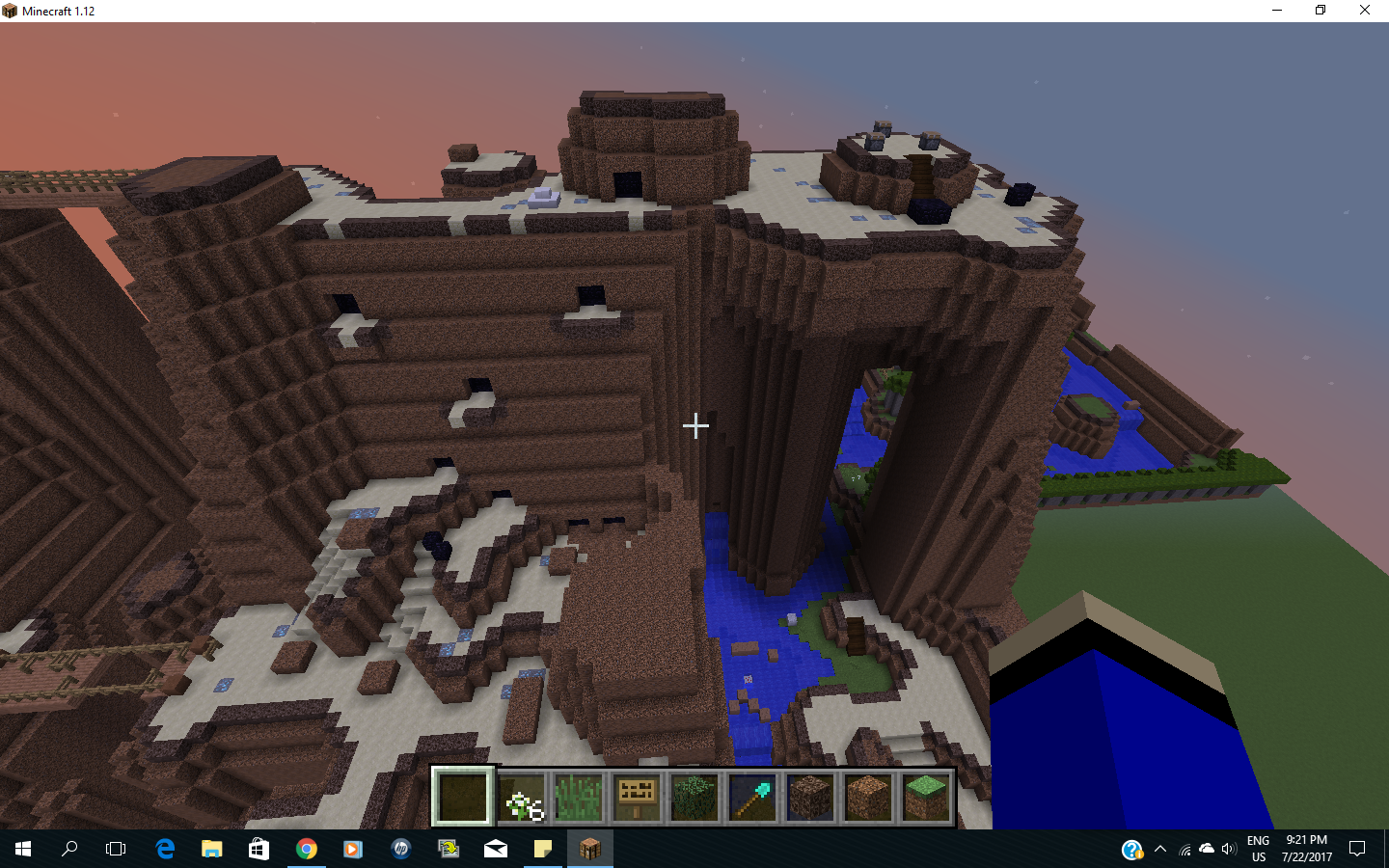
            When I first started it, I was considering making not only the world, but the insides of the buildings and dungeons as well. However, I quickly discovered that this would be impossible: as with many video games, the buildings were bigger on the inside than the outside. Besides, I was beginning to understand the scope of the task I had undertaken. I wasn’t certain I would ever complete it, when at the end of my first session all I had was this:


            Of course, starting is always slow. The second day went much faster as I learned the rules I needed to follow to convert the 2D world into the 3D one. I had thought it would be easier, as both games were built on a block-like grid, however in the original game they were able to place objects halfway between two squares – something it was impossible to do in Minecraft. So, I had to take some artistic licence. By the end of day two, I was quite happy with the progress I had made.


            From there on, my rendition of the map steadily grew as, piece by piece, it came together.


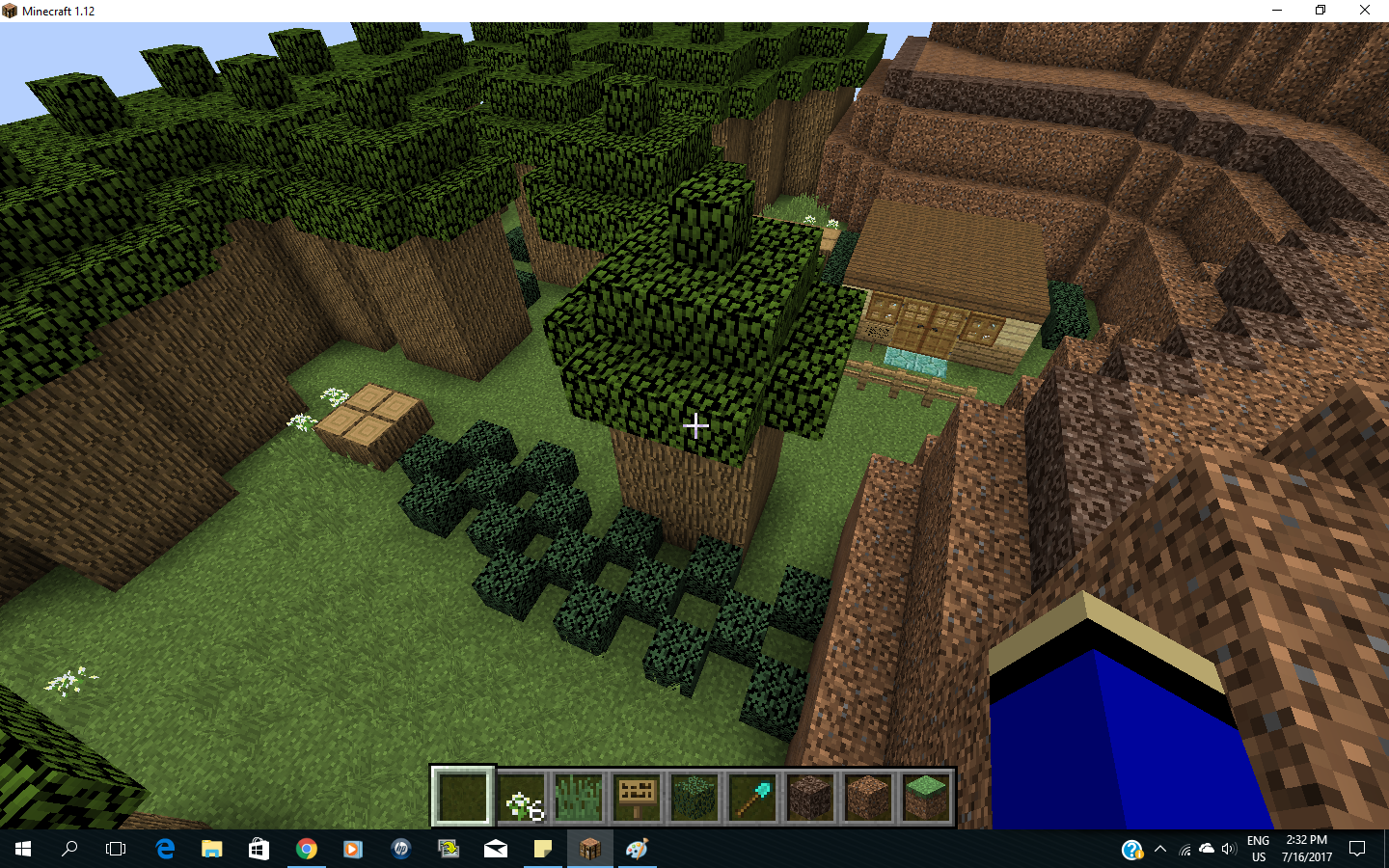
            I did find I had to make a number of adjustments to the map, just to make it hold together. I needed to stretch a small section of the world so that it the rest of the world would pass behind Hyrule castle, rather than through it. As it was, the back of the castle had to be a sheer drop. However, the most annoying part was when I built Kakariko village, only to find that – what with all the ledges dropping ground level – the game designers had, thanks to the 2D nature of the game, created an Escher-like world. Luckily I had enough space to build a steep hill and connect the sections of the world as they were meant to be.


            In spite of the struggles, I was delighted with the results of my work. I was building locations that would be instantly recognizable to anyone who had played the game.


            When I completed the Master Sword’s grove....


            ... I knew I had come to the final, and most challenging, part of my task. This was the point where I would find out if I was going to complete this project, of give up on it. Death Mountain: the mountain that looms over all of Hyrule. And I have to admit, I came close to quitting when I had built most of the mountain only to discover that I had to move the whole thing (I don’t use mods or commands, so it was all done one block at a time).


            But, I persevered – and when part of the mountain still overlapped somewhere it shouldn’t, I improvised and made it make sense.


            Welcome to the The Legend of Zelda: A Link to the Past’s kingdom of Hyrule, Minecraft style. Or, as I like to call it, The Legend of Minecraft.


Click here to find the charity anthology containing a couple of my short stories.


Also, make sure you check out my wife's blog and her website.


If there's any subject you'd like to see me ramble on about, feel free to leave a comment asking me to do so.

Monday, June 12, 2017

Work or Play?

            I have often wondered about the appeal of certain aspects of video games. These aspects are not, by any means, in every video game, but they show up in a lot of them. So, why is it that we enjoy playing games that, when it comes right down to it, are a whole lot of work?

            I’m currently playing one of the older versions of a game called Harvest Moon. This is a game series where you play a character trying to run a farm in a little village. You basically have to build the farm up from scratch while trying to make money and trying to be part of the small community (maybe even getting married). But there is only so much time in the day, your character only has so much energy in a day, and you start with very little money. In the beginning, the game is all about time management and money management – once you get a ways in and have your farm established, it’s about maintaining a daily routine to keep your farm going. Doing the same thing, day after day after day.

            Sounds an awful lot like work, doesn’t it?

            Another game that I played way too much of when I was younger is Runescape. This is a Massively Multiplayer Online Role Playing Game. There are many aspects to the game, but an important part is trying to get various levels raised. At lower levels, this is fairly quick and easy, but at higher levels you can literally spend days just mining, or cutting down trees, or fighting monsters, or cooking, just to gain one level. Day after day, doing the same thing.

            Hey, that sounds kinda like work, doesn’t it?

            Even in combat-heavy games like Starcraft or Call of Duty, you get an aspect of this – at least if you’re competing against other players and want to do well. You don’t just pick up a controller and become the best on the team – you have to work at it. At the professional level you have to practice and train, day after day.

            Doesn’t that sound like...? Well, yes, okay, at the professional level it is work, but you get my point.

            I believe the presiding theory about this is that video games give a sense of accomplishment without any risk to the gamer. This is a fair theory – you gain a level, and that is a reward for all your hard work. You defeat a difficult opponent and they reward you with treasure. You accomplish the same repetitive tasks one hundred times and you earn an achievement.

            Yet, it’s still just another type of work. Yeah, we don’t take it seriously because it’s a game, but it’s still work. And the general consensus is that work is bad and boring.

            What this tells me is that work can be made fun. All it takes is some gameification – the process of turning life into a game. Like Mary Poppins always taught us (not the blue one). This can be done fairly easy with a variety of apps, or simply setting goals and rewards for oneself, but that only goes part way.

We need employers finding ways of making their workplaces more fun. Having a fun work environment wouldn’t only make employees happier about going to work, it would raise productivity as people try to earn achievements or beat their best score. It would likely improve the employee-customer relationship – especially if the customer was happier at their job.


The augmented reality – being developed by companies such as Magic Leap – would make transitioning workplaces into fun, game-like environments almost simple. Can you imagine what the world would be like if everyone loved their job? That’s a future I’d like to see.


Click here to find the charity anthology containing a couple of my short stories.


Also, make sure you check out my wife's blog and her website.


If there's any subject you'd like to see me ramble on about, feel free to leave a comment asking me to do so.
Monday, January 16, 2017

Language and Code

            So, back in the fall I decided I wanted to learn programming. It wasn’t the first time I decided this – I’ve long had an interest in making my own video games and such – but this time I actually went ahead and did it.

            I started with a few free phone apps, but quickly came across a slight problem – most of the apps were teaching me a programming language without really explain how to code. It all seemed to assume I had a pre-existing knowledge of coding and programming terminology and, as such, I had to extrapolate a lot of information from context.

            When I came to the end of the free lessons in the best of these apps (it didn’t even tell me which programming language I was learning – I believe it was either Java or Javascript), I decided to look for something that taught a bit better. To refine my search, I decided to look for a specific language tutorial rather than casting my line out and seeing what I caught – my thought being that if I could find something that taught well enough, the terminology and skills could transfer to other programming languages.

            I decided to lean C programming, as my research revealed it to be one of the core programming languages. My search soon popped up with this site for C++, an upgraded form of C. Within the first few lessons, I knew I’d come to the right place. Rather than just telling me how to code, it goes into detail about how programming works, so I actually understand what I’m being taught to do. There’s even a review from a university professor saying this free online textbook is the best programming textbook he’s ever seen.

            So, now I’m buzzing along, learning to code and loving it – it comes naturally to me and feels like one of the things my brain was designed for. I’m not very advanced yet, mind you, but I’m getting there and making a list of programs to write once I have the skill.

            For now, though, I thought I’d share with you one of the things I find the most interesting about programming. It’s one of the things that inspired the thought process of, oh, three blog posts ago – how everything is broken into smaller pieces.

            You see, a programming language is just that – a language. It has certain words you use to combine together that tell the computer to do something. A line of code is like a sentence – only it ends with a semi-colon rather than a period. Code is broken into paragraphs called functions that look something like this:

Type of function and its name()
{
            Lines of code that give the computer its instructions;
            Just for appearances, we should have multiple lines;
            After all, a single sentence paragraph is boring;
            Also, there are usually more numbers;
}

            A program as made up of a bunch of functions (among other things) and they work together through logical progressions to make whatever the program is for happen. Just like how words, sentences and paragraphs fit together to tell a story.


            It makes so much sense, yet it never occurred to me that that was how it would work. When you think about it, the familiar structure makes it easier for programmers learn the new language. Plus, as with everything else in life, it means that if something is too big to accomplish, it can be done by breaking it down into smaller, more manageable, pieces.


Click here to find the charity anthology containing a couple of my short stories.


Also, make sure you check out my wife's blog and her life coaching website.


If there's any subject you'd like to see me ramble on about, feel free to leave a comment asking me to do so.