Showing posts with label friends. Show all posts

Monday, December 24, 2018

Season's Greetings

            I could write some deep, philosophical blog, or perhaps some nonsensical banter. Perhaps a short review, or some lengthy discussion on D&D or some other game. I could dig up some anecdote from my past, or ramble on about the future, yet none of that seems apt for today.

            Today, regardless of who you are, or what your beliefs, I would like to wish you a happy holiday season. If you’re spending time with friends and family, I hope you get along and have a great time – and if you’re not, I hope it’s because you’re happier that way, or that you at least engage in some activity that makes you happy.

            It’s a time of year full of celebration, but also one where the weather or old memories cause a great deal of depression or sadness. If you are such a person to be afflicted by such things, I’d like to remind you (because it’s easy to forget) that not all times are bad, and this, too, shall pass. I wish you the most cheery time you can manage and hope that the hard times pass sooner rather than later.

            I hope you all have a wonderful midwinter feast and joyous times, be they from games with friends or some quality time with a good book. Be kind to yourself and to others – that goes for the whole year round, too.


            And greetings to you from Salt, Pepper, Cinnamon, Ginger, Nutmeg, Oregano, Parsley, and all the other seasonings.


Check out my YouTube channel where I tell the stories of my D&D campaigns.

Click here to find the charity anthology containing a couple of my short stories.


Also, make sure you check out my wife's blog and her website.


If there's any subject you'd like to see me ramble on about, feel free to leave a comment asking me to do so.

Monday, January 08, 2018

D&D Brings People Together

            When Colleen and I signed up to start playing Dungeons & Dragons at a local board game cafe almost two years ago, I honestly had no idea what to expect. We’d played D&D with friends and family before, and enjoyed it, but the games had never lasted long. It seemed likely that a pay-to-play game with a set schedule would have a good turn-out. It was also a bit experimental for me because I find socialization to be extremely taxing, so it was a test to see if I could handle it.

            We were very surprised when we got to the game and discovered that we already knew one of the other players – a member of a home-school group we’d run some chainmaille workshops with. As more players came in, I was impressed to see such a diverse age range. Here we had a group of people with the youngest being twelve and the oldest in their forties. All had different amounts of experience (both with life and D&D), but we all had interest in the same game.

            The fascinating thing is how well the group got along, right from the start. We were a random group of people who had signed up for this game, and from the moment we started playing it was like we’d known each other for years.

            I may have passed it off as chance, but when we signed up for the follow-up game, the same thing happened. Two of the players from the previous game had been replaced, but the newcomers were welcomed in and got along well with everyone.

            Then, last spring, we signed up for the third game being run by the same Dungeon Master, and it happened again. We had one of the other players from the first game and three brand new ones, and this group got along even better than the others. And when, over the eight or so months that the game ran, two of the players had to leave, the players that replaced them fit in well and also got along with the group.

            Now I’ve seen it happen again, this time from the perspective of the DM – the one running the game rater than playing in it. A group of random people were brought together, from teens to forties. A few knew each other, but they were mostly strangers – yet here they were, playing a game together and becoming fast friends.

            It’s been amazing to experience and observe. We’re generally expected to only get along with people in our own age-group, and it’s supposed to be hard to make new friends – yet, here I have evidence that this isn’t the case. All you need is a set time and place, and a good tabletop role-playing game.


            Dungeons & Dragons brings people together.


Check out my YouTube channel where I tell the stories of my D&D campaigns.

Click here to find the charity anthology containing a couple of my short stories.


Also, make sure you check out my wife's blog and her website.


If there's any subject you'd like to see me ramble on about, feel free to leave a comment asking me to do so.
Monday, September 18, 2017

Did You Hear?

            Last Saturday at the Royal Medieval Faire, we reconnected with the friend we made there last year. At one point throughout our many conversations (he spent much of the day at our tent) he mentioned that, having read last year’s blog in which he featured, he had been impressed with how I had actually listened to what he’d said.

            He went on to explain how he finds that people are frequently misunderstanding, misrepresenting, and misquoting things he’s said (that’s a lot of missing). Yet, he felt that my recollection of what he’d said, and the meaning of it, to be quite accurate.

            Now, there’s every possibility that I could have brushed this off as a unique occurrence, except that this wasn’t the first time I’d had something like this said to me. Within the last few months, Colleen has expressed something very similar to me. She has informed me that she has gotten frustrated conversing with other people because of how often she needs to explain herself several times before she is understood. She feels like people don’t actually listen.

            Having heard this, I could recall experiencing the same thing on occasion, and it brought to mind a quote I’d come across some time ago. “Most people do not listen with the intent to understand; they listen with the intent to reply.” (Stephen R. Covey, I believe) It is a most insightful quote and, I fear, very accurate.

            Why is this, though? Why do people put more of an emphasis on replying to what is said than they do on understanding what is said? I suspect that a big part is that there is an assumption that they have understood. When we hear something said, we immediately form an impression of the speaker’s meaning, and we assume that first impression is correct. And, if we are assuming we are correct, why would we bother putting in the extra thought process to examine what we heard for additional meanings? It is much easier to simply stick with the assumption.

            To that we must add that nasty piece of human existence called ‘social expectation’. Silence is often considered awkward, and as such it must be avoided. Therefore, while conversing, it is important to avoid silences by filling them. This means replying as fast as possible, thus relying upon that initial assumption. On top of that, it is assumed in our society that people who think faster are more intelligent, meaning that people who respond faster must be more intelligent.

            If you have any doubts about our social expectations, just imagine a public speaker. When they present what they have prepared, they come across well, but what happens when they are asked questions they aren’t prepared for? They respond right away – and sometimes they answer the question incorrectly and get called out on it later, but all that matters in that moment is that they have an answer. How would your opinion of that public speaker change if, when put on the spot, they fell silent? Or pulled out their phone for a quick Google search to make sure their facts were correct?

            So, the speed at which we reply is of utmost importance to us. However, there is one other key factor in people not listening properly: the imprecision of language. Language is a way of expressing thought, but thoughts are often too complicated to be encompassed by language. Speaking (or writing) is like trying to draw a three-dimensional scene on a two-dimensional piece of paper. You can give an impression of what you’re trying to draw, but it does not actually re-create what it is you’re seeing. Likewise, two-dimensional words can only hint at the extra dimensions contained within the thought process behind them. Even worse, everyone has their own personal interpretation of the meaning of words – slight differences in interpreted meaning can completely alter understanding what someone is trying to communicate.

            So, my trick to actually listening? Stop to consider what was said before replying. Allow those silences to exist while you replay the sentences in your head. But don’t just try to understand the words, try to understand the intent behind them. The better you know a person, the easier it is to understand how they think – use that decipher the true meaning of what they said.

            Accurate communication is incredibly important. Misunderstanding is what leads to a majority of conflicts – pausing to make sure you understand correctly is worth it in the long run.


            Plus, it feels awesome when people come along and tell you how great you are at listening.


Click here to find the charity anthology containing a couple of my short stories.


Also, make sure you check out my wife's blog and her website.


If there's any subject you'd like to see me ramble on about, feel free to leave a comment asking me to do so.

Monday, June 05, 2017

Failure to Win

            We live in a very competitive world. Or, rather, the world is competitive because we’re brought up to be competitive. Win! we’re told. Get out there, do your best, become your best, and win!

            It’s a mentality we either pick up through osmosis, or is outright given to us. When we play a game, our goal is to win. When we play a sport, our goal is to win. When we go to war, our goal is to win.

            Yes, you may say, winning is good. Winning is how you get ahead in life, how you show you’re the best. However, says I, when the focus is on winning, the more valuable part of any conflict is lost.

            Have you ever been playing a game or sport and found yourself despairing because you had no chance to win? Have you ever given up on a puzzle or a problem because it was so frustrating, and you just couldn’t figure it out? Have you ever found yourself in the middle of an argument where you’ve realized you’re wrong, but you keep arguing your point because you have to win?

            Have you ever paused to consider why it is we challenge ourselves to puzzles, why we compete in games?

            ....

            Back when I started highschool, before I fell in with the group of friends I came to spend all my time with, I spent my lunches playing chess. Not as part of the chess club, mind you – I actually stopped playing when that formed. No, I played chess with a specific friend that I met outside French class on my first day of school.

            Now, this friend, to the best of my knowledge, was a genuine genius. I was no match for him at all – he knew all kinds of famous chess plays and I can’t even begin to guess how many moves he planned ahead. I lost every single game. Yet, every lunch hour, there I was – playing a new game. And, slowly but surely, I got better at chess. Much better, because every time I lost, I learned something. Then, one day, I came thiiiiis close to winning...! And the bell rang for end of lunch. But we both agreed that I probably would have one this time, something that delighted us both. I had become quite the strategist.

            Years later, at my grandparents’ house, my brother and I were playing an old strategy game from my dad’s childhood. I quickly analyzed the game and, after a couple rounds, developed a strategy I believed to be unbeatable (I even figured out the one way to counter it, and how to prepare for and counter that counter). I defeated my brother in every round of the game, but at the end, he still wanted to play again. He kept trying different strategies, and I kept winning. Finally, I asked him why he kept wanting to play when he couldn’t beat me. I’ll never forget what he said:

            “You’ve learned only one way to win. I’ve learned twenty ways how not to win.”

            Even more years later, around the end of highschool, I got a strategy game called Khet – basically chess with lasers and mirrors. Once again, I soon came up with a strategy that was nearly unbeatable. I took challenger after challenger, and only rarely lost. But, when I did lose, I discovered that I enjoyed it! In fact, I enjoyed losing more than winning. And I couldn’t even allow myself to lose to get that enjoyment – because the fun came from trying my hardest and learning where I went wrong. The joy came from facing a challenge and growing from it.

            Now, my examples are all from strategy games, but the same applies across everything in life – from a Sudoku puzzle to searching for a job to running a business. Puzzles and games challenge us for the purpose of helping us grow, and we learn far more form losing than from winning. Life will always throw challenges at us, and when we fail we have the opportunity to learn what we did wrong and fix it for the next time.

            Our competitive society puts the emphasis on winning, rather than overcoming the challenge. But have you ever played a game where you were guaranteed to win? Was it fun? The fun doesn’t come from winning, the fun comes from the challenge.

            As a society, we need to shift our focus away from winning. Yes, winning should still be the goal – what’s the point if you don’t try your best? – but the reward should be the challenge.


            Think of how great the world would be if everyone stopped caring about winning, and started caring about the process of overcoming the challenge.


Click here to find the charity anthology containing a couple of my short stories.


Also, make sure you check out my wife's blog and her website.


If there's any subject you'd like to see me ramble on about, feel free to leave a comment asking me to do so.

Monday, May 29, 2017

End of the World

            I’m not going to write a blog this week because Cthulhu destroyed the world yesterday.

            ... Okay, fine, I’ll write one, but only because the previous sentence needs some explanation (we don’t want another War of the Worlds incident, after all).

Yesterday, Colleen, some friends, and I were playing an excellent board game called Eldritch Horror. Someone who is not a fan of the horror genre (such as me) might think that a game with that title might not be their cup of tea, but they are quite likely wrong. It is one of the best board games I’ve ever played.

            The game is set just after the First World War, and the players are a co-operative team traveling around the world trying to save the world from H.P. Lovecraft type monsters. They travel to cities, collecting items and spells while trying to close portals to other dimensions and fighting the monsters that keep coming in through those portals. All the while more portals keep opening, bad things keep happening across the world, and the doom counter keeps going down. If the doom counter reaches zero, a cataclysmic event happens (which is different each game, depending on the Great Old One who is trying to break through). The only way to prevent the cataclysmic event is to solve three “mysteries” which allow the players to save the world.

            In this instance, we were going up against Cthulhu. And, as you may have guessed, out doom counter reached zero.

            We put up a valiant fight, though! In fact, we were so close to winning, it was a heartbreaking loss. We solved the third and final clue on the exact same turn that our doom counter reached zero, releasing Cthulhu into the world. If the order in which event occurred had differed just a little... but they didn’t.

            Surprisingly, this is actually what I like so much about the game – it is a challenge. At any moment in the game, your team is on the brink of failure. It makes the game exciting, and forces you to be both careful and reckless at the same time. My character actually went insane close to the end (putting that investigator out of the game and making me bring in a new one), but even as I went down I saved two others from the same fate as a last hurrah. It was glorious.


            If you ever get the chance, I highly advise trying out Eldritch Horror. Who knows? You may win. Or Cthulhu could destroy the world, giving you a perfect excuse to not write your weekly blog.


Click here to find the charity anthology containing a couple of my short stories.


Also, make sure you check out my wife's blog and her website.


If there's any subject you'd like to see me ramble on about, feel free to leave a comment asking me to do so.

Monday, January 30, 2017

Finding the Middle

            This week I stepped into the middle of a dispute between friends on Facebook. I don’t like to harp on a similar topic two weeks in a row, but such are the times. I’ll tell you what I saw.

            It started with a democrat friend, outraged by recent events, making a blanket statement about republicans. A republican friend of both of us objected to the statement. What followed was a back-and-forth (not too heated, but clearly emotional on both sides) where each stated their opinions on the ideals of those with the opposing viewpoint.

            Normally I don’t say much on Facebook (or elsewhere – I really am a very quiet person), but this time I had to step in. Here was a pair of people, friends, arguing, all the while saying absolutely nothing – communicating no actual information.

            I pointed out to them that this was the exact problem in politics. It isn’t that the opposing side is unwilling to listen (although that plays a part), it’s that when people have differing viewpoints no one bothers to look at or explain why they hold that specific opinion.

            The sad truth of the matter is that most people can’t truly understand something outside their own experience. The most generous people in the world are the poor – people who know what it is to have little, so they share as much as they can with those who need help. People who have never had close experiences with people with mental illnesses (or had one themselves) don’t understand why mental illness is such a problem – and often think people with mental illnesses are just weak or lazy. People who haven’t experienced something don’t have the same frame of reference as those who have – and, as such, they form different opinions.

            But no one bothers to explain; all people do is shout their already formed opinions at each other. Then they dislike each other and go their separate ways, choosing to only spend time with those who agree with them. Then there become two large groups, isolated from each others’ frames of reference. Their own ideals are amplified by sharing them with people who agree, and the two groups grow further apart as their disputes grow bigger. The world gets divided into “us” and “them”.

            On the other hand, if both sides are willing to listen – to question, to explain – then there is truly some hope. Opinions are formed based on our experiences (or just taken from a source we trust), making an opinion on its own meaningless. When two people take the time to figure out why they have opposing opinions, they have a chance of finding common ground or swaying each others’ views. Or they might find they still disagree, but at least they’ll understand why they disagree. That might not seem important, but it is – it’s the difference between thing someone is a stupid, mindless sheep, and understanding that they reasoned out their opinion – even if they did end up with different results.

            When it comes down to it, there are very few people in the world that genuinely want to cause harm. Everyone wants what they think is best. Often they value the same things – they just see things from a perspective so different that it’s hard to relate. But if the two sides come together to share how they reached their views, they might very well find some middle ground – and that middle ground will be all the more solid because of the work it took to find it.


            The dispute between my two friends? Diffused, with both agreeing with the points I made. I suspect they would have gotten there without me anyway, but I like to think I helped to get them (and others viewing the thread) thinking about resolutions. That’s what we need more than anything right now – mended fences and common ground, because the United States are falling apart and there’s only so much the rest of the world can do to pick up the pieces.


Click here to find the charity anthology containing a couple of my short stories.


Also, make sure you check out my wife's blog and her life coaching website.


If there's any subject you'd like to see me ramble on about, feel free to leave a comment asking me to do so.

Monday, December 12, 2016

Tunnelling Through The Snow

            Around this time of year, I always used to hope for a huge snowfall. Not just because it would mean school would be cancelled, but because I needed a lot of snow for my favourite winter activity: building snow tunnels.

            Of course, at the time, I didn’t call them snow tunnels – I called them igloos. This is a misnomer, because real igloos are constructed using blocks of ice (or packed snow), whereas what I made involved tunnelling out a mound of snow. Since we Canadians live in igloos year-round, it’s an important distinction to make. For the purposes of this blog, I’ll periodically call them igloos for simplicity’s sake.

            Anyway, the first time I made an igloo, it was a big family project. My parents, brother and I all worked really hard on it. To this day, I couldn’t say for certain how big that igloo was, because I was rather small at the time – in my memory, it was at least five-feet tall with a diameter of ten feet. Big enough for my entire family comfortably fit in, at least according to me. In reality, it was probably significantly smaller.

            After that initial construction, my brother and I got creative. We built a second, much smaller, igloo and attached the two with a tunnel. My poor mother nearly got stuck in that tunnel – it turns out adults are bigger than kids, but we were so proud of our accomplishment that we wouldn’t let her alone until she’d crawled through it.

            In future years, my brother and I became experts at tunnelling through the snow. This was, in part, for safety reasons. Around this time, there was a great deal of concern about kids getting injured in collapsing snow tunnels. One of my friends (you know who you are, and I know you’re reading this) was only allowed to play in our tunnels with us as long as she kept her head outside. My brother and I felt this was unnecessary because none of our igloos ever collapsed (unless we jumped on them or they melted) – we believe that the any that did were poorly constructed.

            Here are the guidelines we used for making our tunnels:

-          First, only use snow that packs decently. Light, fluffy snow won’t hold together well enough to form a solid structure. It is a good idea, once your pile of snow is ready to be tunnelled, to ensure it s sufficiently packed. To do this, carefully (so as not to leave footprints) climb to the top of the pile and roll down the hill. If the pile isn’t too high, it is also possible to jump lengthwise onto the top before rolling down. Repeat this until the hill is sufficiently packed on all sides and feel free to continue for as long as it’s fun.

-          Second, when tunnelling, make sure the walls are the correct thickness. If they are too thick, they could collapse from the weight. If they are too thin, they won’t be strong enough to hold up the structure. The ideal thickness is right before the point when you can see sunlight through the walls. The best way to achieve this is to tunnel until you can see a bit of light – then pack some snow over top of that and use that location as a guide for the continued tunnelling process. It is especially important to focus on getting the roof the right thickness, since that is the most likely part to cave in if there is a structural problem. In that event, a thinner roof is less dangerous.

-          Third, the don’ts. Don’t freeze your igloo – the process of freezing it will make the structure weaker and, in the event of a collapse, more dangerous. Don’t fill the walls with windows and doors – one entrance is enough, maybe one or two tunnels if you have a complex structure. And whatever you do, don’t jump on top of it – especially if there is another person inside.

Using these guidelines, my brother and I crafted many interesting snow tunnels. From a triplex of interconnected igloos to an igloo fort with a tunnelled outer wall, we had a great time every year we got enough snow (right up into out twenties). It helped that we had a large driveway – big enough to hold 6-8 card or 3 (friendly) dogsled teams. The snow needed to be shovelled anyway, so why not put it all in one place?

            So, if you’re stretched for things to do this winter, and you happen to get a lot of snow, try tunnelling. It’s a great deal of fun – just make sure you stay safe.


Disclaimer: To the best of my knowledge, that driveway has never had a dogsled team parked in it – and no, all Canadians don’t actually live in igloos.


Click here to find the charity anthology containing a couple of my short stories.


Also, make sure you check out my wife's blog and her life coaching website.


If there's any subject you'd like to see me ramble on about, feel free to leave a comment asking me to do so.

Monday, November 07, 2016

Oh, Nothing

            Today I can think of nothing to blog about, so I’ve decided to write about nothing. Nothing has become a favorite topic of mine, ever since a friend introduced me to the topic in highschool.

            To put it simply, nothing cannot exist. The word ‘nothing’ refers to the absence of everything, meaning that there is nothing there. However, being able to define that absentness as ‘nothing’ means that it really is something. It is, in fact, nothing.

            By calling ‘nothing’ nothing, we turn the nothingness into a thing. We define it as something defined by the lack of things. Unfortunately, this means that nothing is, in fact, a thing – albeit a rather abstract one. By definition, nothing is not a thing, yet by calling it nothing, it becomes a thing and is therefore no longer nothing.

            Therein lies the paradox of nothingness. It can only be nothing so long as we do not call it nothing, for as soon as we do it becomes something and can no longer be called nothing.

            So, nothing does not exist. But here is where it gets tricky. There is the distinct existence of nothingness that we can no longer define as nothing. Take space, for example. It’s a vacuum; there’s nothing there. No matter, no particles, nothing. However, calling it nothing is fallacious, because by defining it at all we are acknowledging that it exists, making it the opposite of nothing.

            This means that in order to even acknowledge that something is, in fact, nothing, we must pretend that it doesn’t exist. Because, you know, it doesn’t. It would, therefore, be wrong to call it something (even nothing), since giving it a label means that it exists.

            So, every time you encounter something that you suspect might be nothing, the best way to handle it is to give it the silent treatment. Pretend it doesn’t exist. It isn’t rude because it most likely doesn’t.


            Ah, I could talk about nothing all day. Anyone interested in spending a day in my head?


Click here to find the charity anthology containing a couple of my short stories.


Also, make sure you check out my wife's blog and her life coaching website.


If there's any subject you'd like to see me ramble on about, feel free to leave a comment asking me to do so.

Monday, October 31, 2016

Who Are You?

            As I sit here writing my 200th blog, I can’t help but wonder – who are you? (It helps if you picture me pressing my nose up against my computer monitor, peering into it.) Yes, you, on the other side of this screen, reading these words that I’ve typed.

            Since starting this blog in 2013, it has had almost 10,000 hits. That’s around 50 visits per weekly post – not much, in the grand scheme of things, but pretty awesome considering how little effort I put into finding new readers.

            Now, I know who some of you are. Some are family and I know of a handful of friends who regularly come to read the latest thing that has spilled out of my head. That accounts for five to eight of those visits. There are a handful of others who visit when the link I share on Facebook catches their eye – I’m quite surprised by some of the people who have liked the links; people who I never would have thought would drop by my blog.

            That still accounts for less than half the visits. So, who are you, out there in the ether(net cables)? What is it that draws you to this place where I ramble about who-knows-what?

            Who are you?


            Well, whoever you are, thank you for dropping by. If you didn’t keep coming to read, I wouldn’t keep rambling – then I never would have reached 200 posts. Wouldn’t that be a shame?


Also, happy Halloween!


Click here to find the charity anthology containing a couple of my short stories.


Also, make sure you check out my wife's blog and her life coaching website.


If there's any subject you'd like to see me ramble on about, feel free to leave a comment asking me to do so.

Monday, September 19, 2016

How To Make Friends

            I’ve often heard people say that they have no idea how to make friends. So, I’ve decided to write a brief guide based on my observations of the new friend Colleen and I made this past weekend at the Royal Medieval Faire.

            This guide really only consists of one step: be mysterious. Not in an aloof, dark, mysterious stranger way, but passive way. It’s easier than it sounds. A lot of people are quite happy and eager to talk about themselves and their lives; all you need to do is constrain yourself to only giving occasional pieces of information about yourself. Preferably the most interesting points in your life – and without context, if possible.

            The best way for me to explain is with the story of our new friend. When he first appeared under our tent (where we were selling chainmaille, of course) at the faire, Colleen complimented him on the awesome coat he was wearing. He stuck around for a little, chatting and joining in a conversation we were having with friends from Colleen’s homeschooling group. At some point the style of homeschooling (called un-schooling, which focuses on teaching kids what they’re interested in) was mentioned, and it turned out that he’d also been raised that way.

            I also noticed, while he was there, that he had a piece of string around a finger that led down to what I believed to be the hilt of a dagger hidden in his sleeve. Very interesting, I thought, but at that point I didn’t know him well enough to comment upon it. Eventually he left, going to enjoy the rest of the faire.

            About an hour from the end of the event, he came back to chat with us some more (he no longer hat he dagger in his sleeve). The three of us talked about all kinds of topics, discovering we had lots of common ground. Every now and then he’d mention something about his own life, but he didn’t go on about it. They were just interesting points that made me more curious about him.

            The first thing he mentioned was that he’d only been in Canada for two weeks. Because he had an unfamiliar accent, I took that to mean he had just immigrated, but he clarified that he was native to Canada, but had been travelling in Europe for the past nine months. His accent, as it turned out, was technically a speech impediment as it was unique to him, a couple of his siblings (out of seven) and some guy from a fishing village who deliberately changed the way he spoke so he wouldn’t be associated with others from his village.

            At some point he mentioned how, while in Europe he’d climbed a castle while wearing an Assassins’ Creed hoodie. Later he confirmed that, yes, he can actually do parkour (which is awesome). At another time, when I asked about what kind of work he does, he didn’t directly answer, but did say he was going back to the old job from before he was travelling – then told us about how he’d had to get security clearance first and his option (which he didn’t take) to request “Top Secret” security clearance.

            He ended up staying after the show and chatted while we packed up. He helped where he could (we have a system and it’s hard to fit someone else in), most notably holding a couple bags for about 30 minutes to keep them off the wet ground. That in itself doesn’t sound all that remarkable, but these bags each weighed 30-40lbs and he had them hanging from his forearms, elbows bent, and he didn’t even show any strain from the weight.

            It was at this point that I said to Colleen, loudly enough for him to hear, that he’d had a dagger concealed in his sleeve (he was very surprised that I’d noticed it), he’d just spent close to a year in Europe, he could do parkour, he was impressively strong and he needed security clearance for the job the conveniently hadn’t mentioned what it was. Clearly he was a spy.

            From there, we all had a great time, putting together the snippets he’d told us about to prove he was a spy. He denied being one, of course, although he would neither confirm nor deny being an assassin. He even went so far to point out that the name he gave us might not actually be his real name.

            We had a blast, but I still don’t know what it is he actually does. I’m very curious, and therefore I have no choice but to be his friend so I can find out.

            And there you have it. The best way to make friends is to be mysterious. Make people curious about you so they’ll have to spend time around you to find out more.


            Also, be a spy and wear an epic coat to serve as an icebreaker.


Click here to find the charity anthology containing a couple of my short stories.


Also, make sure you check out my wife's blog and her life coaching website.


If there's any subject you'd like to see me ramble on about, feel free to leave a comment asking me to do so.

Monday, August 29, 2016

Faraway Friends

            One of the great opportunities we have in our modern society is the simplicity of communicating through the internet. We take it for granted now, but just a couple generations ago, it didn’t even exist. If you wanted to talk to someone on the other side of the world, you either wrote a letter (and waited forever for the response to return) or made an expensive phone call (although, if you go back just a little further, even that wasn’t available).

            Now we just pop open the internet and within moments we’re having conversations with people all over the world. Marginalized groups, who previously felt alone in the world, have a way to discover they aren’t as alone as they thought.  People who otherwise would never have met become fast friends.

            Having spent much of my younger life playing online games, I’ve been lucky to have many such friends. More recently, though, my online friends have come in the form of my writing support group, the Alliance of Worldbuilders. We started out as a group focused on giving constructive criticism on each others’ writing, but grew into something much more – a group of good friends from around the world. We even published an anthology of short stories together.

            This week I had the great opportunity to meet one of those friends in person – she was on vacation nearby and she suggested we could get together (last month she had met up with a number of the others in the group who, like her, live in England and previously had met a number of others around the world as well). Opportunities like this rarely arise, so even though it meant leaving my house (blech!) and driving to and in one of the largest cities in the country (blargleblech!!!), Colleen and I decided to go meet her.

            After arriving late because I’d only planned for half the bad traffic we encountered, we the three of us hit it off fantastically. I think we actually got along better in person than online. I had expected that we’d visit for maybe an hour, but we ended up chatting for over three hours an everything from writing to social issues to plotting global domination (forget I said that last one). My first meeting with an online friend was a huge success.

            For me, it highlighted the wonderful opportunities afforded to us through the internet. It had the marvellous capability of bringing together people who, in a past age, could never have met. What’s so great about this? The discovery that all the people across the world aren’t all that different from ourselves. Previously, all we could go on for picturing people of other nations was derived from meeting a few here and there, maybe travelling, and hearing from other peoples’ descriptions of then. This, of course, all gets simplified down into the stereotypes that still survive today.

            Yet, now, those stereotypes are tempered by the ability to go online and talk to almost anyone. We can really meet and find out about each other; discover how similar we are. In spite of the people clinging to the past – insisting it’s us against them – cultures from around the world are being brought closer and closer together.


            What a wonderful potential this has for changing how we view the world.


Click here to find the charity anthology containing a couple of my short stories.


Also, make sure you check out my wife's blog and her life coaching website.


If there's any subject you'd like to see me ramble on about, feel free to leave a comment asking me to do so.

Monday, August 15, 2016

Strange Gatherings

            One of the most fascinating things to me is how quickly complete strangers can bond over common interests. This could partially be because I, as an extremely introverted person, tend to prefer staying home and avoiding as much social interaction as possible. The idea is somewhat alien to me that people actually seek out social situations. That said, I do occasionally emerge from under my rock to mingle with the living.

            Last Thursday was one such occasion. The vast excitement over Pokemon Go had bred whole new social circles. There are now Facebook groups focused on helping each of the three in-game teams co-ordinate their catching and gym battling efforts within their city, as well as sharing their latest victories.

            On my team’s local group (team Mystic), the idea came up to throw a PokeParty at one of the local parks – just to get together, meet each other, have a barbeque and maybe battle the nearby gym. Within a few weeks, the pavilion was rented and the event was organized. They even decided to open the even to the rival teams.

            So, Colleen and I thought, why not? We went down to the park with my sister-in-law to see what it would be like, catch some pokemon, and maybe meet some people if it couldn’t be avoided.

            Now, this was an all-day event, which was nice for making it available for people with many different schedules. The flip side was that the result was that, rather than a whole lot of people, there was a small amount of people there with the members changing throughout the day. As an introvert, I greatly approved of this.

            For most of the two hours we were there, there were seven of us there. We flipped between hanging out as a group while eating hamburgers and wandering between the nearby pokestop and gym. All of us got along astoundingly well – not surprising, since we were all team Mystic.

            Then the gym was claimed by some team Valor players. Through struggling back and forth for control of the gym and watching the nearby people, we were able to identify the three rivals who were, like us, wandering between the pokestop and gym. So, after we claimed the gym a filled it full of magikarp (Pokemon players will understand how hilarious this is), one of the party’s organizers approached the Valor players and invited them to join us for some hamburgers.

            So, the party grew – and, despite the playful trash talk (now mostly aimed at the not-present team Instinct players), we all got along wonderfully. While I wasn’t there for the rest of the event, I think it can be considered quite a success.

            It’s even more interesting, though, when you look at our current society. We’re told from childhood to beware of strangers. We avoid all contact with people we don’t know. It’s like we have this fear that anyone we don’t know is a horrible person, or someone we wouldn’t get along with.

            Yet, all it took was a single point of interest to bring together a group of people who would never have spoken to each other. Not only that, but that point of interest (and food) was enough to ignore that we were on rival teams and competing for control of a gym. There was reason (at least for extremely competitive people) to be antagonistic, but we were all friendly.


            It seems to me that all it takes for people to get along is one thing in common. I wonder how much better a place the world would be if people, when looking at others, looked at the similarities rather than the differences (and maybe shared some food).


Click here to find the charity anthology containing a couple of my short stories.


Also, make sure you check out my wife's blog and her life coaching website.


If there's any subject you'd like to see me ramble on about, feel free to leave a comment asking me to do so.

Monday, November 02, 2015

Everyone is Important

            Earlier this week, a friend of Facebook shared an image that said, in essence, “Remember that everyone you encounter changes your life in some way.” The next day, a friend with no connection to the first shared an image saying, “Remember that you change the lives of everyone you meet.” Both say the same thing from opposite perspectives and that coincidence must have lodged in my subconscious, because look what I’m blogging about today!

            This is a view on life I’ve had from a very young age. Everyone effects everyone around them, perhaps in small ways, but even the smallest influence can be significant.

            For me, one of my best examples goes back to when I was writing my first book (not including the picture book I wrote when I was six) – around age eleven or twelve. At this point in time, I was still at the stage where I imitated other writers – in this case Brian Jacques with his anthropomorphic animal characters.

            My brother, in his first year of highschool, had a friend a few years older who was also writing a book. My brother arranged for me to swap books with this friend so we could give each other feedback. The feedback I received from this person I’d never met yet took me a huge leap forward – he gave me the confidence to stop imitating and become my own author.

            In addition, this same friend lent my brother R.A. Salvatore books, which I started reading as well. He became one of my favourite authors and those books had a huge impact on my views of the world. There are some philosophies in the books that, rereading them recently, I discovered I’d been expressing to other people almost word for word without knowing it.

            It is amazing for me to think that someone with so loose a connection to me and who I only met once (at that point in time – a decade later he started working in the same plaza as the pizza place I worked. We started chatting, realized our past connection, became friends and, eventually, my wife and I shared an apartment with him for two years) could so influence my entire life thereafter. That’s all it takes, though! Most people never realize how the most insignificant seeming thing can change the lives of people around them.

            A lot of people also wonder about their importance in the world and weather they make a difference. The answer is yes. You are important. I am important. Everyone is important. Just because you can’t see how far your reach spreads doesn’t mean you make no difference.


            Everyone’s lives are made up of a myriad of connections. Even a slight tug on a tread of their lives can cause ripples that carry on forever. So, remember that the next time you feel insignificant. Without you, the world would be an entirely different place.


Click here to find the charity anthology containing a couple of my short stories.


If there's any subject you'd like to see me ramble on about, feel free to leave a comment asking me to do so.

Monday, March 16, 2015

Teaching D&D

            I always enjoy watching people learning to play Dungeons & Dragons for the first time – which is what I was doing tonight. A friend of mine works in a store that is going to start running the official Wizards of the Coast gaming sessions and tonight, in preparation, he was running a game for new players. He asked me (as an experienced player) to come along to help advise the new players.

            The important thing to know about D&D is that it’s a storytelling game, specifically designed to give the players as much freedom as possible. As such, it can be a little complicated to learn – but the hardest thing to learn, I feel, is that you’re allowed to think outside the box and bend the rules to suite your needs.

            The best story I have to describe this involves a game I was playing that was run by the same friend. I had encountered a door that, to get through it, my character had to will himself through – becoming part of the door before passing through. So, I asked that, if my character could will himself to become part of the door, couldn't he also will the door to be part of him? After looking shocked for a moment, my friend agreed. My character absorbed the door and walked around, able to manifest a door at will.

            That’s the sort of game D&D is – anything goes and, in a society built around such solid rules, that’s a hard thing to learn. This group of players did a splendid job, however. At first, they stuck to the mechanics of the game, but while they were in a room with what sounded like an army coming after them, they became more and more creative in finding ways to secure the area. They started with trying to wedge a knife under the door to keep it shut and eventually tried using an ice spell to freeze the doors together.

            The best part is I hardly had to suggest anything. All the players picked up the game quickly and flowed right into it. A lot of credit needs to be given to me friend running the game – he taught the basics and prepared brilliantly for working with new players (if I ever teach a new group again, I’ll take a leaf out of his book). The end result was everyone had fun and there are now a bunch of new people hooked on D&D.


            I bet we could get a lot more outside-the-box thinkers in the world if more people played D&D. Maybe we should teach it in schools. Ah, if only I were the ruler of the world...


Click here to find the charity anthology containing a couple of my short stories.


If there's any subject you'd like to see me ramble on about, feel free to leave a comment asking me to do so.

Monday, January 19, 2015

Internet Anonymity

            Recently, Canada instated a new law to help prevent internet piracy. This law allows copyright holders to request internet companies to issue warnings to people who have illegally downloaded content. For example, if you were to download a song from your favourite band, the band could have your internet service provider inform you that continuing to download more of their songs could lead to a law suit. Your identity and personal information would remain confidential, but could be made available if legal action is taken (a nice balance between respecting privacy and enforcing copyright laws).

            This got me thinking, as you may have guessed, about the anonymity of people on the internet. In and of itself, the internet has become almost a whole world of its own. People on the internet can be whoever they claim to be and do what they like with few (or no) consequences. This anonymity has many benefits, particularly relating to privacy, but it also has the negative flip side – bullying, scams, viruses, piracy and various illegal activities.

            So, I'm wondering... what would happen if the anonymity of the internet was taken away?

            I'm not saying that I think this should happen, or even that it could – it would require the agreement of the entire world and we all know how likely that is to happen – I'm merely wanting to explore it as a theoretical exercise.

            If every time someone logged into the internet, wherever they went, their real names and faces would be registered. If, every time they interacted with people online, it was with their real names and faces. Would people behave differently?

            Personally, I think they would. The risk of going to illegal download sites or other sites they don’t want people to know they've been on would be greater – and if that is enough incentive to stop them from going, maybe they shouldn't be going there in the first place. People who bully online would no longer be hiding behind false personas. The risk of being banned from a site or online game would be greater if they were getting banned, rather than just the account that they could make a new one of.

Simply by removing anonymity, the internet could become a much friendlier place.

            Of course, there’s always a flip side. The first thing that comes to mind are predators, although they could be tracked by their true identity online as easily as their prey. So, the real problem would become the new generation of hackers specialising in using other peoples’ identities online – possibly an increase in the ease of identity theft. Would it be possible to police such activities? In a world where anonymity on the internet was abolished, would our society have evolved to a point where nothing can be gained from identity theft?

            It’s an interesting thought, really, especially with recent generations who've gotten used to their anonymity online. It really isn't as big a step as we think. Internet service providers already track the websites we go to (even though the information is kept confidential) and there is so much information on the internet that even the basic internet security that we teach isn't always enough.

            As a perfect example, I’ll tell you a story of my own youth. I spent much of my early teens playing massively multi-player online role playing games – particularly one called Runescape. My awareness of internet security was impeccable – bordering on the paranoid. I never gave out my name and the closest I’d come to telling someone where I lived was my province or country. I gave out very few personal details, even to the closest of my online friends.

            One my friends on Runscape was a Dutch woman name Paula who was around the same age as my parents and had kids my age. We became so close that we started referring to her as my Dutch Mom. Still, I didn't give her much information on myself, so you can imagine my surprise when I received a birthday card in the mail from her on my 16th birthday.

            I’m fairly certain I’d only given her the month of my birthday. As to how she found my address... that came from small, unimportant pieces of information I let drop in casual conversation. She knew my country and province, my first name, a famous hockey player who was born in my city, and that my parents owned (at the time) a driving school (of which there were several in town). With that small amount of information, she’d was able to find me – and that was ten years ago when there was far less information available on the internet.


            So, as I said, we’re already not as anonymous as we think. The question is, would the internet become better/safer or worse with the removal of anonymity? What do you think?


Click here to find the charity anthology containing a couple of my short stories.


If there's any subject you'd like to see me ramble on about, feel free to leave a comment asking me to do so.

Monday, August 18, 2014

Cottage Time

            Once in a while, my wife and I get invitations to visit a cottage, but we rarely are able to accept – actually, this is the first vacation we've had since our honeymoon, two years ago. I suspect that this trip was partially planned around us, since we left for the cottage on Wednesday, shortly after our last show before the end of September – in other words, the first free time we've had all year.

            This particular cottage is owned by some family friends and I've come up here a couple times before with my in-laws. It is a wonderful, relaxing place to come – if I could, I’d live up here. Oh, and the view is great.


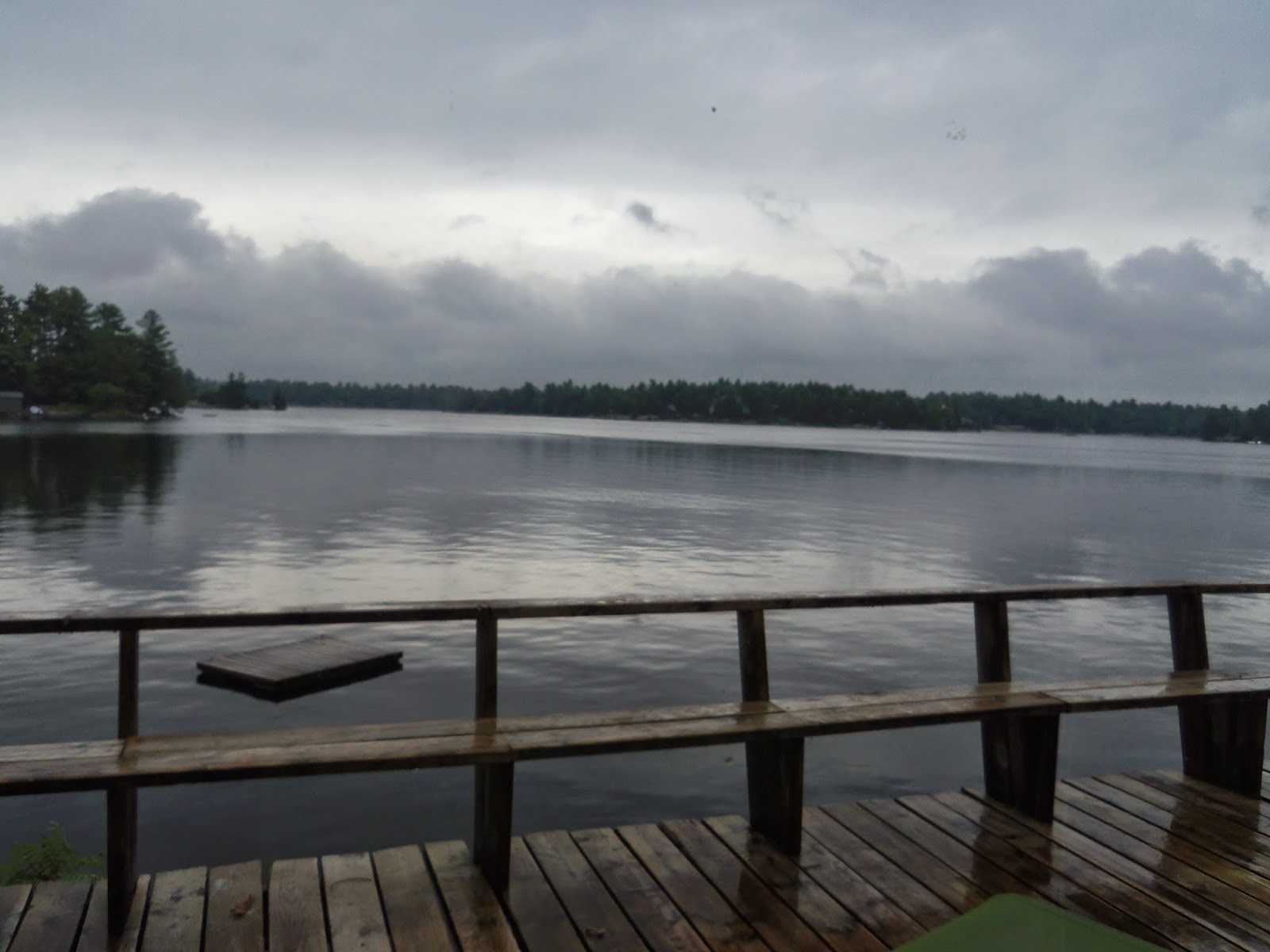
            Not that this is the exact view I've had the whole time I've been here. It is accurate for my previous two visits, however today is the first day I've really gotten a chance to enjoy being outside. It’s also the first time the first day that the sun has come out to play (it’s back behind a cloud again now). Much of the time here looked more like this:


            In spite of the weather, it’s still been a great vacation. The friends and my in-laws are a delightful to spend time with, even cooped up inside by the rain. Plus, during the precipitation, we got to hear and see this lovely loon:


            It’s kind of funny, though, because even though I'm on vacation, I'm still working away. My wife and I brought chainmaille to make while here and I, of course, am writing every day. Actually, of my five books (including my current work in progress), this is the third one I've worked on at this cottage. Without all the distractions of regular life, I get far more done here than I do at home, while, at the same time, being more relaxed.

            I can’t help but think how wonderful it would be to live like this all the time, without the hubbub of every-day live interfering with... just living. I wish everyone could live like this and experience the simple joy of slowing down and enjoying life for what it is, rather than what we've made it.


Click here to find the charity anthology containing a couple of my short stories.


If there's any subject you'd like to see me ramble on about, feel free to leave a comment asking me to do so.

Monday, May 26, 2014

The Challenging Art of Seating Arrangements

            On Saturday, my wife and I went to the wedding of our former roommate. It was a lovely wedding that took place at a beautiful historical building. The ceremony itself was outside, and the weather was absolutely perfect (although, we did end up sitting next to someone) and the reception and dance were held inside one of the estate’s buildings.

            Weddings are always interesting to go to, particularly when you get to the reception, because you never know who you’re going to know there or who you’ll be sitting beside. I've been to three weddings in the past two years (not including mine) and I've come to realise just how challenging it is to do a good job making a seating plan (working on the plan for my own wedding helped with this, too).

            The first of the three weddings was a friends’ wedding, but it was a wedding for a friend of both myself and my wife who we met through the theatre group my wife was a part of for several years and that I was part of for a show. So, naturally, we ended up at the “theatre friends’ table”, full of people we knew.

            The second wedding was my wife’s cousin’s. So, my wife and I knew a number of people, but not that many. This time we were put at a table with my sister-in-law and her boyfriend, as well as four people we never met before – cousins from the groom’s side of the family. At first, we were surprised, until we started talking with them. We then very quickly established that we were at the “geek” table (wearing a chainmaille tie helps bring out that sort of thing) and I don’t think any other table had as much fun as we did. The bride confirmed with us later that it had been very intentional.

            That brings us up to this last wedding – a friend’s again, but a bit different this time. It was a small wedding and we didn't know that many people there – we knew the bride and groom (of course) and had met the groom’s parent’s and the bride’s aunt and uncle a couple times. The only “guest” we knew well was the groom’s cousin who we used to play Dungeons & Dragons with, but we couldn't be at the same table as him because was the best man. The result was that we got seated at the “Well... where else can we put them?” table. This is the table that shows up at almost every wedding where awkward silences usually abound.

            Not this time, though. One of the other people at our table was the bride’s former (horse) riding teacher. We started talking to her early on and found out that her date had cancelled at the last minute and, as a result, she knew no one else there. She and my wife bonded over their ADD (and, later, over their mutual love of Supernatural), and we ended up chatting with her most of the night. We said less than ten words to the others seated at our table, but talking to her was a blast (she’s close to 60, teaches Zumba and has recently started power-lifting. Wow!).


            I guess it goes to show that, even though the challenging art of seating arrangements often results in a table of mismatched guests, that can end up being the funnest to be at. Either that or my wife and I (both introverts) just happen to be the life of the party.


Click here to find the charity anthology containing a couple of my short stories.


If there's any subject you'd like to see me ramble on about, feel free to leave a comment asking me to do so.

Monday, February 24, 2014

Farewell to Con-G

            I know I write about conventions a lot, but that’s because they’re so awesome! Besides, this one was special.

            One year ago, we of Ringcrafts were vendors at our first ever convention, Con-G. It was a wonderful show for us and gave us great hopes for the future of our business. We were welcomed with open arms by the other vendors and artists and we even became friends with a number of them.

            Most of those friends we ran into again at other shows we attended throughout the year, at the same time as meeting new friends. As I've mentioned before, there’s a truly wonderful community of people on the selling side of the tables – although some of the friends are regular convention attendees as well (my wife and I seem to have accidentally acquired a daughter who is, somehow, around the same age as us).

            So, the year went by and we've just come full circle, this past weekend being Con-G once again. Since was our first second year vending at a show, I was astonished by how many attendees I recognised! Some were even wearing jewellery or carrying dragons that they bought from us last year (I got to meet the person who ordered the first custom dragon I sold online and one of the people who won a dragon in one of my Facebook draws). Even though I’d only seen most of them once before, it was like getting back together with old friends.

            Part of what made this show so great for us was that the convention’s mascot was a dragon that I’d been able to design a chainmaille version of. Last year, I’d only made one – since I had no idea how well any of the dragons would sell. It sold on the first day. This time I wanted to have five along, but there was a mistake made on my materials shipment and I could only make three. Luckily, after the first three sold, I was able to modify other dragons to make two more. Even that wasn't enough – I even have one ordered for the next show I'm at.

            Of course, part of the reason those dragons sold so well is the sad news that this was Con-G’s last year. The same people have been running it every year and they don’t have the time to continue with it any more. Everyone’s very sad, but it helped make this an event to remember. With any luck, someone will pick up the torch in the future and resurrect this wonderful show.


            So here’s to Con-G, the first show, the first second year show, and the first last show I (and Ringcrafts) have sold chainmaille at. Thanks, Con-G team, for six great years (well, okay, so I can only say two great years, but I'm sure the first four were just as good).


Click here to find the charity anthology containing a couple of my short stories.


If there's any subject you'd like to see me ramble on about, feel free to leave a comment asking me to do so.