Showing posts with label nature. Show all posts

Monday, September 24, 2018

Turtle For A Day

            This week brought a fun little adventure to our house. On our way home during our morning walk, Colleen and I came across a very adorable baby snapping turtle, who was unwisely crossing a road. So, we decided to help the little fellow out.

            He was very friendly, though he certainly wasn’t fond of being picked up by his still-soft shell – he used his little legs to push at the fingers holding him until Colleen decided to let him stand on her hands for the rest of the walk home. This led to him walking with us, in a manner, as he began walking on his own as well – with Colleen putting one hand in front of the other for the determined little guy. And he always seemed to want to go in the same direction – towards the sun. To us, this validated our decision to interfere with nature, as his path would have taken him across the road, into a farm field during plowing season, then across a far busier road into another farm field which he would have to cross before reaching something that vaguely resembled safety.

            We got him home and made him a temporary tank to live in until we could safely relocate him. There was some small desire to keep him as a pet, or to keep him around for a few days before returning him to the wild, but he clearly didn’t like his enclosure and he nearly constantly tried to escape. We also decided that he was too young for us to keep him very long without risking harming his ability to survive in nature – he was so young that he still had his egg-tooth and a small amount of whatever the egg-equivalent of an umbilical cord is. Plus, he was an at-risk species in the region, so we needed to get him back out into the wild as soon as we could.


            So, as soon as we had a moment of time, we took him out to where we’d decided he would have the best chance at survival. We considered taking him to a nearby park which had ponds, but we decided that the high-traffic and fishing in the area might not be good for such a little turtle, so instead we took him to part of the trails we walk on where there is a nearby stream, figuring that it was roughly the direction he was heading in and about halfway between the ponds and where we found him – so if his instincts were taking him to the pond, he would have a much shorter journey, and only one infrequently used road to cross.
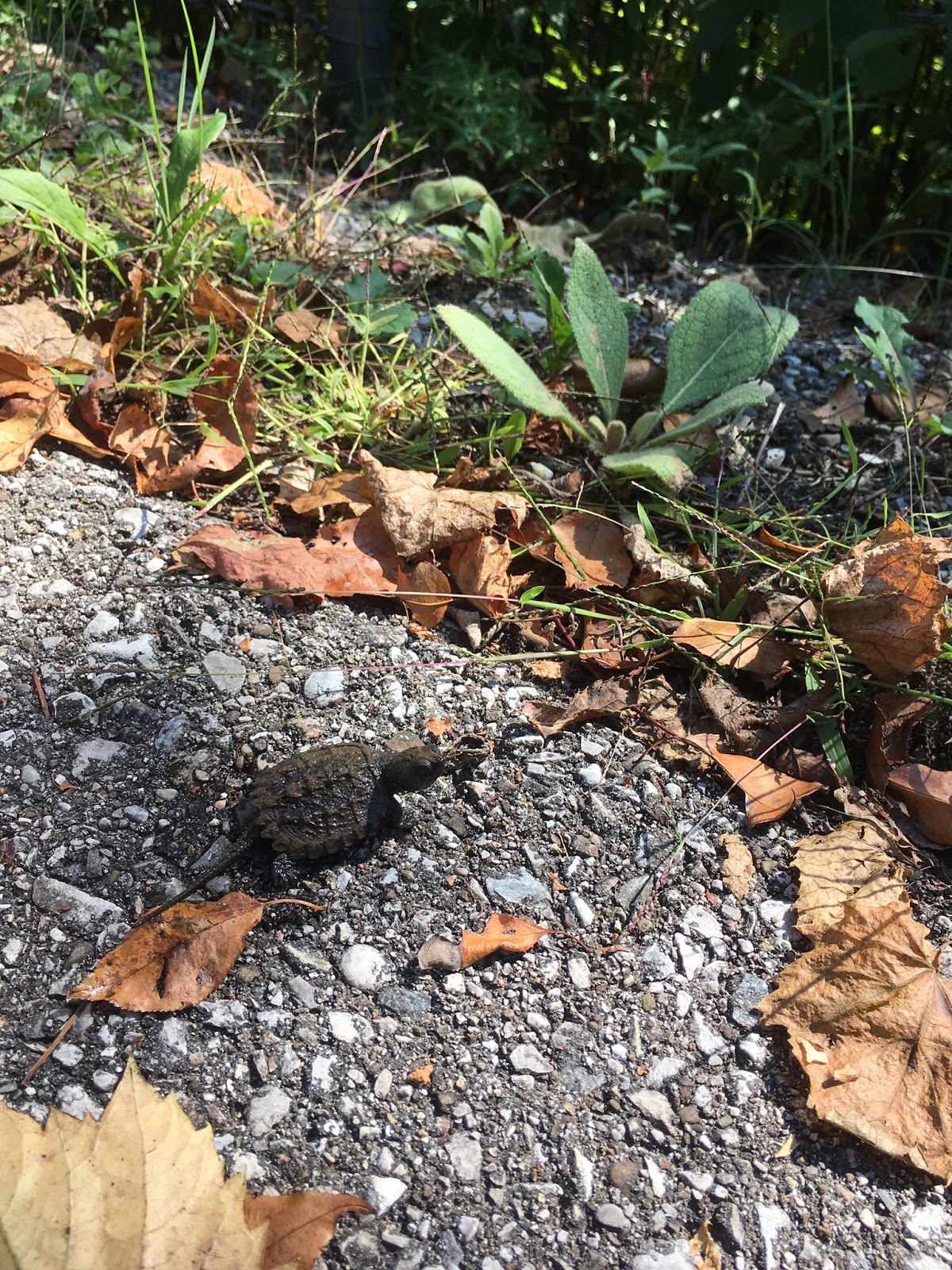


            We deposited him on the side of the trail, pointed in the direction of the stream, and here his movement stopped. All this time, he had been moving fairly consistently – either walking along Colleen’s hands or trying to escape his makeshift tank, though he never hissed or bit at us, or showed any sign of aggression. He just stood there, his neck stretched out so he could look over his shell at us as we loomed above him, waiting for him to walk off. It was an interesting moment, as he seemed more curious than anything. I couldn’t help feeling that he had some small amount of understanding of what we were trying to do for him, or at least that he was exceptionally confused as to why we were letting him go.

            After this had gone on for some time, we finally gave up on him and lifted him one last time to move him directly into the underbrush where he would be safer, should he decide to continue being statuesque.

            We have no way of knowing if what we did actually helped him, or if he will survive. We very much hope that his interaction with us hasn’t taught him that he has nothing to fear from predators. However, we do believe that what we did gave him a far better chance at survival than his plodding course across busy roads and farms would have. We’ll probably never know – but, on the other hand, perhaps someday we’ll come across a much larger snapping turtle on the trail. Then he’ll let us know what he really thought about our little rescue operation.


Check out my YouTube channel where I tell the stories of my D&D campaigns.

Click here to find the charity anthology containing a couple of my short stories.


Also, make sure you check out my wife's blog and her website.


If there's any subject you'd like to see me ramble on about, feel free to leave a comment asking me to do so.

Monday, October 16, 2017

Frogger Game of Life

            Last night, while driving home in the pouring rain, I saw a brownish-yellow leaf on the road, highlighted by my headlights. As the car drew nearer, the leaf seemed to be lifted by the wind and carried in two arcs to the side of the road. In fact, it looked almost like it was hopping.

            The idea was still forming in my mind that it may have been a frog (or toad) when I saw another one. This one was sitting on the edge of the road and I was able to distinguish that, yes, this was some type of amphibian, and it confirmed my suspicions about the previous ones I’d seen.

            Having identified the first two frogs, I was then able to spot more – and there were a lot along this particular stretch of road, all trying to get to the other side. Luckily I was able to avoid hitting them, but it did get me thinking about the situation.

            Had it not been for the specific lighting provided by the combination of the rain and the headlights, I never would have seen those frogs. And while some of them expertly dodged the car, Frogger style, there were others that I actively steered around – those ones would certainly have ended up squished and I never would have known. Perhaps they ended up flat anyway, courtesy of another car with a driver who didn’t notice their presence, or perhaps one who did notice and simply didn’t care.

            It struck me as a perfect metaphor for the relationship between humans and the natural world. For centuries we’ve blundered around, shaping the world to fit our needs. Sometimes, some of us notice that we’re causing harm and we do what we can to stop it. Others of us never even notice the harm, or refuse to believe harm is being caused. Some people are aware of the harm and just don’t care.

            The greatest threat to the frogs are the people who don’t even know they’re there. We could, of course, tell them that the frogs are there, but we humans are a skeptical lot. We like to see things with our own eyes. What we really need to do is provide the correct lighting conditions so people can see the frogs for themselves. Then it’s up to them what kind of person they want to be.


            Personally, in life’s great game of Frogger, I want to be the type of person who helps get the frog safely across the road.


Click here to find the charity anthology containing a couple of my short stories.


Also, make sure you check out my wife's blog and her website.


If there's any subject you'd like to see me ramble on about, feel free to leave a comment asking me to do so.

Monday, September 25, 2017

Plant Overlords

            Have you ever stopped to wonder at how remarkable our world is? I mean, take plants, for an example. They draw nutrients from dirt, water, and the sun. They then rearrange those nutrients to form building blocks to make the plant larger – and they may seem like they grow pretty slow, but if you compare them to humans they grow at an alarming rate. They also just happen to filter the air into something other life forms need to breathe.

            Of course, plants then become food for animals. The animals draw nutrients from the plants they eat, once again converting them into the building blocks they need to grow. And then other animals eat those animals, and so on.

            And then they all die. Bugs eat them (and are, in their turn, eaten) and turn them all into nutrient-rich dirt – which goes on to feed the plants.

            As if that circle of life wasn’t remarkable enough, just look at how life symbiotically helps each other. Look at plants, once again. By providing pollen and nectar, they feed creatures that can then spread that pollen, helping the plants to reproduce and spread their populations. Plants are so useful as a food source and as building materials that humans plant vast fields of them and raise them with great care.

            In fact, it’s so convenient that it almost seems orchestrated. I mean, we actively raise plants, spread them, feed them, protect and nurture them, and exhale the carbon dioxide they need. Then, when we die, we (eventually) become a rich food source for them.

            It’s almost as if our whole existence revolves around serving the plants. Like the plants are farming us and keeping us dependent upon them by feeding us (or our food) and granting us breathable air.


            All hail our beneficent plant overlords.


Click here to find the charity anthology containing a couple of my short stories.


Also, make sure you check out my wife's blog and her website.


If there's any subject you'd like to see me ramble on about, feel free to leave a comment asking me to do so.

Monday, March 06, 2017

Evil Vegetarian Elves

            Of late, I’ve been reading the Inheritance Cycle (by Christopher Paolini) to Colleen. As a result, you now get to hear about one of my biggest pet peeves in fantasy: vegetarian elves.

            To start off with, I should probably say that this is in no way an attack on vegetarianism or veganism – it is merely my opinion relating to an aspect of world building.

            Now, I completely understand the concept of elves being vegetarian – from a certain perspective, it makes complete sense. Elves revere nature and life, so wouldn’t they be opposed to killing animals?

            However, I can very easily refute that argument by saying: take a close look at nature. In nature, it is kill or be killed. Eat or be eaten. Yes, some animals eat only plants, but that’s because they lack the ability to eat meat. Elves are one with nature and, as such, would partake in the natural cycle of life. To abstain from eating meat would be to elevate themselves above nature.

            That said, it is also important to go back to the roots of modern fantasy. Tolkien. This is where we start, because prior to Tolkien, elves were all short sprites like the ones who help Santa. Tolkien reinvented the race into what is used in most stories.

            So, were Tolkien’s elves vegetarians? No. Thanks to the movies, this isn’t common knowledge because the idea that elves are vegetarians is so widespread that it managed to get into Peter Jackson’s interpretation. However, in The Hobbit, when Bilbo and the dwarves are in Mirkwood, they find themselves on the outskirts of a hunt – involving elves hunting a white elk. Later they come upon the elves feasting and, yes, meat is mentioned.

            This is the point where we reach why this becomes a pet peeve of mine. It can easily be argued that each writer is at complete liberty to make their world whatever they want it to be, which is entirely true. So what’s wrong with vegetarian elves? Internal consistency.

            When aspects of a world are created, even a fantasy world, they have to make sense. For that, let’s look at the common traits elves always have. Pointed ears. Graceful bodies. Keen eyesight and hearing. Exceptional archery skills.

            This last one is the problem. Exceptional archery skills. Why are elves exceptional archers? They are generally a peaceful race, so they would have no need of weapons unless threatened – at which point, they’d have to learn pretty fast to be that good at archery. There are easier weapons to use. No, they aren’t exceptional archers for the purposes of war – it is because they are hunters. And as they are so attuned to nature, they would not hunt for sport – only for food. Thus, for elves to have archery skills (and tracking skills, for that matter), they must eat meat.

            All of that said, it is possible for elves to be vegetarian – the world building just has to match. And, while it was his books that inspired this post, Paolini actually did a good job on the world building end of making his elves vegetarians – they have a reason for their choice and instead of exceptional archery, they’re simply very good at all forms of fighting due to their age, magic, and super-strength (making them more like Vulcans than traditional elves).


            So, in conclusion, elves can eat whatever they want – but the world and their abilities had better support their food choice.


Click here to find the charity anthology containing a couple of my short stories.


Also, make sure you check out my wife's blog and her life coaching website.


If there's any subject you'd like to see me ramble on about, feel free to leave a comment asking me to do so.

Monday, May 16, 2016

Aliens and Abduction

            While I’ve always been open to the idea of other life in the universe (it’s such a big place, after all), I’ve also always been quite sceptical about the idea of said life abducting and experimenting on humans. Then I had a look at how humans treat the wildlife of the planet.

            Now, I’m not suddenly a believer in such things, but my scepticism has shifted from “That’s ridiculous, why would they do such a thing?” to “Well... we do it, why wouldn’t they?”

            Our biologists and other experts regularly traipse out into the wild. They will observe animals in their natural habitats and, sometimes, capture them. They will then do various medical examinations on the animals before releasing them. Sometimes, they’ll tag them or give them tracking collars – or implants.

            This all seems quite normal to us, but what must it be like from the animals’ perspective? Does a captured sloth, upon being returned to its family, saying (very slowly), “I swear! I was abducted by humans! They experimented on me and put in this implant.” The poor thing would, of course, be met with jeers. “Phaw! Humans don’t exist! Even if they did, they wouldn’t experiment on you.”

            So, I’ve come to conclude that, in the unlikely event that there is a species out there so advanced and so different from humans that they view us as wild animals, there is a possibility that they would abduct and experiment on humans.


            On the other hand, for a species to be so vastly different from humans that they need to study us to understand us, I wonder if we aren’t imposing upon these hypothetical beings more human nature than they would have.


Click here to find the charity anthology containing a couple of my short stories.


Also, make sure you check out my wife's blog and her life coaching website.


If there's any subject you'd like to see me ramble on about, feel free to leave a comment asking me to do so.