Monday, August 07, 2017

Swords & Wizardry

            Yesterday I had the delightful experience of playing Swords & Wizardry, which is essentially a revamped version of the very first version of Dungeons and Dragons (available for free from Frog God Games). Aside from being a lot of fun, it gave me a glimpse at what the game was like back in the day. Apparently, back then, Dungeons and Dragons was far more deadly for the characters.

            Before I get into some of what happened in the game, I think it’s important to note some major differences between Swords & Wizardry and modern D&D. The biggest difference is that the newer game is more about storytelling – you put a lot of work into your characters and their back story and the game, and there is a big focus on why the heroes are adventuring as they are. The older game is what we call a dungeon crawl – while there is still some story, the primary goal is to fight through dungeons and gather as much treasure as you can. The difference may not seem very big, but it leads into the second major difference: balance.

In modern D&D, when your characters end up in battle, it is almost guaranteed that you can win – because the game is designed to be balanced. S&W is not so kind. It functions under the more realistic assumption that, were you to go out adventuring, whatever you ran into was what you ran into – it doesn’t matter if you’re level one, you can still encounter something like an ancient dragon that you can’t even hit. This, combined with the third major difference, makes for a high mortality rate.

            In newer games, there are a number of abilities and skills to help your character detect traps, secret doors, and a variety of dangers. Not in the old games – no, you have to specifically say your character is looking at something for you to see it, which means it is way easier to walk into traps.

            So, essentially, in D&D you go into the game expecting to make a character that is not all that likely to die, whereas in S&W you go in expecting that your character will die, so you’re prepared to make a new one so you can rejoin. The way characters’ ability scores are rolled – in newer games, you usually roll four six-sided dice, add the top three together, and then assign that number to whichever ability you want it in. In the old game, you roll three six-sided dice and fill in the stats from top to bottom – making them completely random. As you can see highlighted in red on my character sheet below, that doesn’t always turn out very well.


            For frame of reference, the highest roll possible is 18. Anything below an 8 is really bad, and for something to be useful it needs to be 13 or higher. As you can see, this character’s only decent ability was charisma which, in this game, is almost completely useless. However, the one thing it is good for is having hirelings – extra people paid to follow your character around and do their bidding. And so begins the epic tale of Gorbon the Slovenly, the halfling thief – the character with the worst stats anyone had ever seen, and who, starting with only 3 hit points, we all thought would be the first to die (but we joked he’d be the only one to survive in the end).

            While the four other adventurers were spending their starting money on armor and weapons, Gorbon the Slovenly bought a push-cart, hired two men-at-arms and ten torch-bearers (the cheapest minions around, who can’t even fight – I later claimed many of them were hired from an orphanage). Gorbon paid all his hirelings a week in advance and promised them a share of whatever treasure they helped him carry back. He then climbed into his pushcart and sat back to relax as his minions carted him around.

            The adventurers were then sent to retrieve a book from a temple that had been taken over and desecrated by an evil cult. En-route, they stopped to investigate some desecrated shrines. The statues of gods within had been beheaded – only one head was still around. Gorbon promptly ordered one of his minions to put the head back on the statue. However, the moment the torch-bearer, lifted the statue’s head, he burst into flame and died.

            The amount of damage done by the magical trap – hidden on the bottom of the head an impossible to detect – was enough that it could have outright killed any of our characters except the ranger. It was an eye-opener for the players as to what kind of game this was.

            Gorbon the Slovenly, however, was unconcerned. He heaved himself out of his cart, wobbled over to his fallen minion, and looted the week’s advance pay. He then climbed back into his cart, ready to move on. One of the other players jokingly called the dead torch-bearer “Jimmy” and I resolved to name every one of my minions when they died (you can see the list on the righ-hand side of the character sheet).

            I think I’ve given a good idea of Gorbon’s character by now, so I’ll skim to some more interesting parts. In a secret tunnel, he lingered behind to steal four valuable tapestries that the “lawful” characters wouldn’t take because it would be sacrilegious. When some very powerful spiders attacked the group in a forest, six more torch-bearers died and a seventh (I named him Bilbo) fled into the forest, chased by one of the spiders. Gorbon stayed in his cart, shooting arrows, while keeping his men-at-arms at his sides in case anyone came too close. After the battle, he looted his money back from his dead minions and the adventurers moved on.

            At this point, I started doodling Gorbon being pulled in his cart, along with his dead minions, around the outside of my character sheet. Yes, there is a little corpse for each dead minion – they shall not be forgotten.

            They finally arrived at the temple, thanks to the sacrifice of Gorbon’s minions – of which there were now two torch-bearers and two men-at-arms. That quickly became one torch-bearer when to one Gorbon sent ahead into the temple was killed by another magical trap (on the ceiling we hadn’t thought to look at).

            From this point forward, Gorbon became more careful with his minions, as he needed them to pull his cart. The remaining three survived as everyone fought skeletons, wound their way through a secret passage and into tunnels. However, they came to a place that to proceed forward they had to climb over short walls – the cart had to be left behind. And as soon as they were in one of the parallel tunnels (both with the barricades), an enormous ogre attacked the party from behind.

            When the ogre crushed the group’s other (much better) Halfling thief into jam with one blow, Gorbon took his minions and ran – straight into the ogre’s lair. There he spotted treasure and paused long enough to order his men-at-arms to grab a chest of it, then circled back to his cart via the second of the parallel tunnels.

            By a stroke of luck (a critical hit, for which we had an awesome deck of cards to generate special results), our human fighter beheaded the ogre. Gorbon hid the chest on his cart and assured the others that he had been circling around to attack from behind, not merely fleeing.

            The adventurers found a great deal of treasure in the ogre’s lair, loaded it into the cart, but left it where it was and continued on foot (joined by the paladin that replaced the dead thief) down a side passage – much to Gorbon’s dismay, as he was counselling them to return to town to hire more minions with their treasure. They fought some skeletons, then came upon a wight – which cast a spell of fear that caused all but two of the adventurers to run away. One joined his fleeing companions, while the ranger (having been drained to level 1 by the wight which we couldn’t hurt without silvered weapons) stayed behind and sacrificed himself.

            The spell wore off when they were halfway into the woods. Gorbon convinced everyone to go back for the treasure, then go into town – they agreed on the condition that they run at the first sign of trouble. They collected the treasure and made it back to town without trouble, where they bought silvered weapons. Gorbon opened his secret chest to find three potions, one of which was poison and killed his last torch-bearer who was testing them to identify what they would do.

            Gorbon hired twenty more torch-bearers. All the other characters, being “lawful”, couldn’t bear the thought of hiring people and sending them to their deaths, so they set out again. By the time they reached the temple again, three torch-bearers had fled and another eleven had been killed by orcs and spiders.

            We then took a different route in the temple, that led us to a room that spawned four skeletons every two rounds that a “lawful” character was in it. Gorbon wisely told them to retreat, but the other adventurers decided that there couldn’t be that many skeletons. When the cleric died (leaving only two of the original adventurers alive), the remaining three decided to run to the exit on the far side of the room, the whittle down the remaining skeletons once they stopped spawning. Gorbon, still in the first hallway, had his minions pull him all the way back to the edge of the forest while he fired arrows at the two skeletons chasing them. There he was joined by the cleric’s replacement, who was a “neutral” character (he’d learned his lesson) that helped slay the skeletons.

            Back inside, the other skeletons were killed off, but not before one of the three was knocked unconscious. The new “neutral” character crossed the room to join them, but Gorbon the Slovenly stayed behind – his henchmen were all lawful, and he wasn’t going to go on without them (or his cart), and he certainly wasn’t going to let them spawn more skeletons. He did, however, go far enough into the room to loot the dead cleric.

            The remaining three adventurers carried on until they found a large glowing rune. The two “lawful” characters (one carrying their unconscious companion) stood back while the “neutral” character opened the secret door, breaking the rune and, in so doing, summoning an frog-demon which magically changed all but the fighter (the second last of the original adventurers) into its minions. The fighter dropped his unconscious companion and fled – but not fast enough. The frog-demon destroyed him, and walked deeper into the dungeon with its new minions in tow.

            And so it was that Gorbon the Slovenly, he with the worst stats anyone had ever seen, was the only one to survive the adventure. In the end, the game claimed the lives of five adventurers and twenty torch-bearers. A further three torch-bearers fled home, and one was lost in the woods, being chased by a giant spider.


            We still don’t know if poor Bilbo survived.


Click here to find the charity anthology containing a couple of my short stories.


Also, make sure you check out my wife's blog and her website.


If there's any subject you'd like to see me ramble on about, feel free to leave a comment asking me to do so.

Monday, July 31, 2017

Rush Hour

            On my way home from a convention today, I found myself being passed on the highway by every other vehicle. Not just the occasional ones that is normal for me – usually there’s a mix of some passing me, me passing a few, and most going the same speed as me – but all the other vehicles. I wasn’t driving slower than usual, but I did realize this was rush hour. And I started to wonder why it was that everyone was in such a hurry that they would risk speeding tickets (and not small ones, either).

I figure that part of the reason is that most people don’t know how useless speeding actually is. If I look back to times I was in a particular hurry, I found that at the fastest speed I was willing to drive (admittedly not all that much over the speed limit – what can I say? My parents owned a driving school when I was growing up) I managed to shave a whole five minutes off a drive of more than an hour. That’s really not worth the trouble.

But then, I realized, it was unlikely that these people were all on a schedule to get somewhere. Not in the evening. They were most likely going home. So many people, rushing to get home – risking speeding tickets and, judging by the speed, the potential to lose their licences to get home.

            And I realized that what was most important to them was the feeling of getting home as fast as possible – the feeling that they had stolen a few more moments to spend time with their family, work on personal projects, play video games, or do whatever it was they want to do with their lives.

            So many people feel like they don’t have enough time in their lives – and let’s face it: they don’t. There are some extraordinary people out there who can balance professional and personal lives and be perfectly happy, but I don’t think the average person can. Otherwise, why would so many people daily risk the severe consequences of driving dangerously just to scrape a few more moments of time to themselves?


            It seems that I have added yet another reason to my belief that the average work weekshould be cut in half (with the economy adjusted to accommodate it). Not only would it improve mental health, make people happier overall, and increase the number of jobs for the workforce, but it would make people safer drivers because they wouldn’t feel like they had to rush around to have enough time to spend on what they want to do.


Click here to find the charity anthology containing a couple of my short stories.


Also, make sure you check out my wife's blog and her website.


If there's any subject you'd like to see me ramble on about, feel free to leave a comment asking me to do so.

Monday, July 24, 2017

The Legend of Minecraft

            Today I shall share with you the results of a project I started back at the end of December. While it’s true that I was working on this over the past seven months, because of the on-and-off nature of the time I spent on it, I feel it’s safe to say that the work itself only took a month or two.

            The project started when I decided to play through my collection of Zelda games – something I do once every few years. However, I was having trouble convincing myself to start playing the first one. The Legend of Zelda: A Link to the Past is a game from my earliest gaming days, back when the Super Nintendo was the hottest system on the market. As a result, I’ve played it so much that I pretty much have it memorized.

            I wanted to do something that would make this play-through of the game more interesting – and to make it last more than a couple days. So, I came up with the idea of combining it with another game: Minecraft. As I played through the A Link to the Past, I was going to build the world map in Minecraft.

            And now, at long last, it’s done.


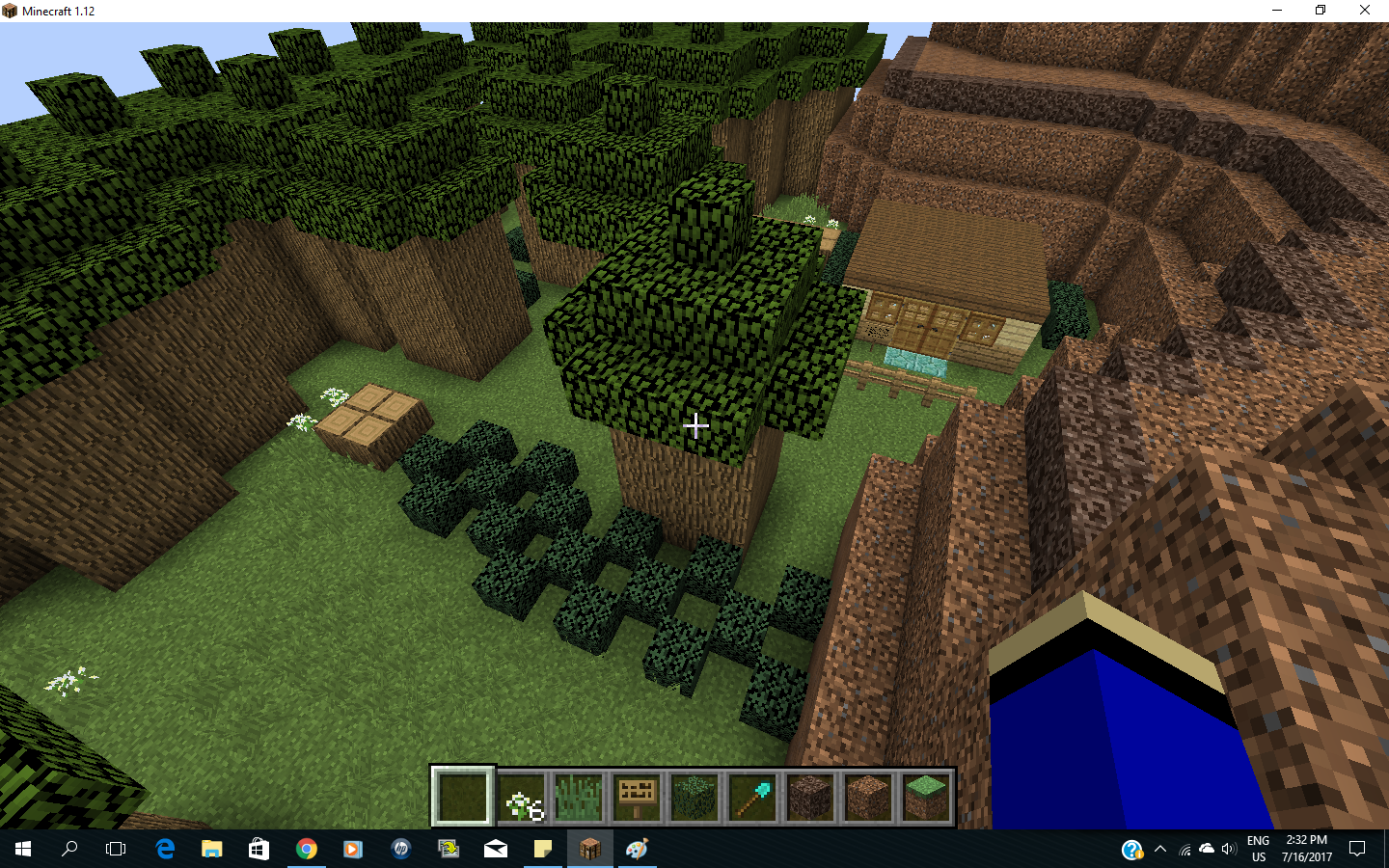
            When I first started it, I was considering making not only the world, but the insides of the buildings and dungeons as well. However, I quickly discovered that this would be impossible: as with many video games, the buildings were bigger on the inside than the outside. Besides, I was beginning to understand the scope of the task I had undertaken. I wasn’t certain I would ever complete it, when at the end of my first session all I had was this:


            Of course, starting is always slow. The second day went much faster as I learned the rules I needed to follow to convert the 2D world into the 3D one. I had thought it would be easier, as both games were built on a block-like grid, however in the original game they were able to place objects halfway between two squares – something it was impossible to do in Minecraft. So, I had to take some artistic licence. By the end of day two, I was quite happy with the progress I had made.


            From there on, my rendition of the map steadily grew as, piece by piece, it came together.


            I did find I had to make a number of adjustments to the map, just to make it hold together. I needed to stretch a small section of the world so that it the rest of the world would pass behind Hyrule castle, rather than through it. As it was, the back of the castle had to be a sheer drop. However, the most annoying part was when I built Kakariko village, only to find that – what with all the ledges dropping ground level – the game designers had, thanks to the 2D nature of the game, created an Escher-like world. Luckily I had enough space to build a steep hill and connect the sections of the world as they were meant to be.


            In spite of the struggles, I was delighted with the results of my work. I was building locations that would be instantly recognizable to anyone who had played the game.


            When I completed the Master Sword’s grove....


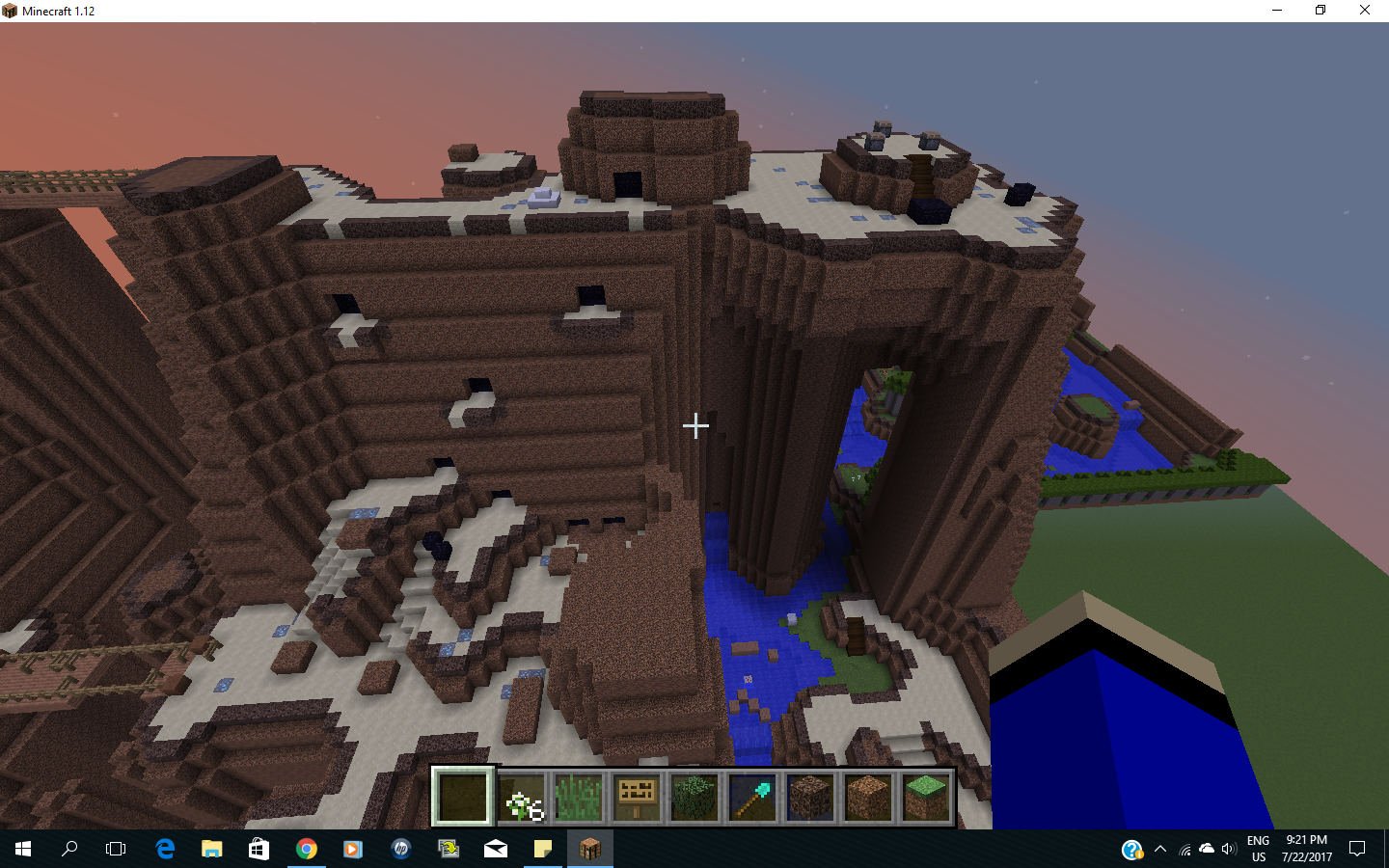
            ... I knew I had come to the final, and most challenging, part of my task. This was the point where I would find out if I was going to complete this project, of give up on it. Death Mountain: the mountain that looms over all of Hyrule. And I have to admit, I came close to quitting when I had built most of the mountain only to discover that I had to move the whole thing (I don’t use mods or commands, so it was all done one block at a time).


            But, I persevered – and when part of the mountain still overlapped somewhere it shouldn’t, I improvised and made it make sense.


            Welcome to the The Legend of Zelda: A Link to the Past’s kingdom of Hyrule, Minecraft style. Or, as I like to call it, The Legend of Minecraft.


Click here to find the charity anthology containing a couple of my short stories.


Also, make sure you check out my wife's blog and her website.


If there's any subject you'd like to see me ramble on about, feel free to leave a comment asking me to do so.

Monday, July 17, 2017

Building a Playable World

            This week, I managed to get my nose to the grindstone working on a big project I started back in June. This is a campaign setting for Dungeons and Dragons.

            Back when I was in the planning stages for the D&D marathon for Cystic Fibrosis, I was talking with the Dungeon Master of the weekly game I play in and the idea was floated that I could eventually start running a second game at the board game cafe. I liked the idea, but at the same time I prefer to be a player rather than a DM. At the same time, I knew that there was a waiting list and it would be great for the gaming community.

            So, naturally, I began thinking about the possibilities for games I could run. What did I want to see in a game? What would be fun for me to run, and fun for players to play? And that’s when a seed took root in my mind.

            One of the things that makes D&D such a great game is its versatility. You can do absolutely anything with it. Even in the most complex video game, there is a limit to the decisions a player can make – they can be given a great amount of freedom, and still be chained down by the limited options. In D&D, there are no limitations – yet the games frequently take on the same shape of “Here is your quest”, go to the dungeon, get the reward. There’s often plotlines and political situations woven in, but it doesn’t take advantage of D&D’s true ability to do anything. I feel that this is largely due to the players, having been trained by video games and society’s expectations, don’t necessarily understand how much freedom they have – and they don’t necessarily understand the depth of the world they’ve been thrown into.

            And so, I came up with an idea for a world that will (hopefully) open the players’ minds to all they can do: a world where the players are colonizing a “new world”. So, rather than being thrown into a world where there are kingdoms and empires and complex political structures that they know nothing about, the players will be put into a world that is as strange to the non-player-characters around them as it is to them. This puts the players at the centre of everything as a new society is established, and it gives them the freedom to do absolutely whatever they want. Do they want to help establish a settlement? Do they want to go off and explore the new world? The world is entirely open for them to choose what to do.

            Now, obviously, from a DM’s perspective, a world like that is a bit challenging to run. There needs to be plots to keep the players engaged, and in a world so free and open, it is hard to know what to prepare for the game. So, I started writing up the campaign setting – which is, essentially, a description of the world, everything in it, and guidelines for making the world easier for the DM to run. It is an immense task, but hey – I’m part of the Alliance of Worldbuilders; building worlds is what we do.

            So far, it is coming along well. I’ve outlined the world, its history, and the basics for how the game functions. The functions need a lot of work, but I’ll get them done eventually.

            This week, however, I was focusing on a very fun task: monsters. Even though this world lacks civilization (and, largely, because of that), this world is crawling with monsters. So, I combed through D&D’s monster manual and cherry picked monsters to have established societies in this world. Then I created those societies and figured out what politics they had, both within themselves and with all the others.


            It was so much fun and, let me tell you, I can’t wait until I’ve completed this setting and I get to see it in action. Who knows? I may even decide it’s good enough to publish through the Dungeon Masters’ Guild.


Click here to find the charity anthology containing a couple of my short stories.


Also, make sure you check out my wife's blog and her website.


If there's any subject you'd like to see me ramble on about, feel free to leave a comment asking me to do so.

Monday, July 10, 2017

Bug Eyes

            Watching a bug today, I started wondering what the world must look like to something so small. Certainly, everything is bigger – a crumb would be like a large rock – but are there any differences to how they actually see?

            Certainly, bugs must see more details than we do – much like how a piece of fabric looks like something solid from a distance, while the closer you get the more individual threads you can see. But is that where it stops?

            Through the use of microscopes, humans can examine things too small for them to see. We can break objects down into their individual parts. To insects, those parts are so much bigger in the first place. So, can they already see them? Does your vision become more magnified the smaller you get?

            If so, that must mean that the smallest of bugs view the world on a molecular level. How strange that must be, to look at something and see all the pieces it was made from. Like being able to count all the bricks in a wall, only the wall is a crumb.


            Oh, the knowledge we could glean if only we could communicate with other beings.


Click here to find the charity anthology containing a couple of my short stories.


Also, make sure you check out my wife's blog and her website.


If there's any subject you'd like to see me ramble on about, feel free to leave a comment asking me to do so.

Monday, July 03, 2017

Unstoppable Creativity

            You’d think I would have learned by now. Because I haven’t, I’ve now broken my cardinal rule. That’s right, I’m working on more than one book at a time.

            It may not seem like such an important rule. Loads of people work on more than one book at once, so why is it such a big problem? Well, it’s a problem because it gives the writer an excuse to not finish a project. The Dark Lord of the Alliance of Worldbuilders is a prime example – he’d written 100,000 words or more in a single month (wow!) and yet, to my knowledge, he had never completed a book (we all give him a hard time about it).

            Now, in my case, I couldn’t help starting a second project. As I mentioned a few blogs back, I’m currently working on rewriting a project. Apparently, after seven years of writing every day, rewriting isn’t enough of a creative outlet for my brain. After a while, an idea surfaced that I couldn’t resist – so now, here I am, splitting my writing time between two projects when I should be focusing on one.

            It just goes to show that creativity is a habit. Once you get into it, you just have to keep going.

            Feel free to take that as encouragement to build a creative habit – or a warning to avoid doing so. Whichever suits you best.


            Either way, know that you can’t stop the creativity. Creators must create.


Click here to find the charity anthology containing a couple of my short stories.


Also, make sure you check out my wife's blog and her website.


If there's any subject you'd like to see me ramble on about, feel free to leave a comment asking me to do so.

Monday, June 26, 2017

Expectations

            When selling products at shows, there is a distinct type of let-down felt when a usually successful show turns out otherwise. It is quite different from poor sales at a new event, where the success of the show is unknown, or somewhere where sales have been poor in the past.

            It all comes down to expectations. If you go into an event expecting success, the joy is less when you are successful and the disappointment worse when you are not. On the other hand, if you expect failure, you won’t be disappointed when you fail, and you’ll be overjoyed when you succeed.

            Looking at the end results of expectations, the next logical step is that it’s a good idea to always expect failure. After all, then you won’t ever be disappointed and you’ll be very happy if you succeed. However, there is a glaring flaw in that logic: your performance.

            If you go into everything expecting it to fail, you will put less effort into it. Worse, you’ll likely be unhappy, which will have a negative impact on everything you do. As a result, you’ll be less likely to succeed.

            Ah hah! says Logic. In that case, expecting to succeed should make you more likely to succeed! And yes, that is true – but only to a certain degree. The sad truth is that it is far easier to fail than succeed. Yes, you’re more likely to succeed if you’re expecting success, but there are too many elements outside your control for that alone to lead to success. In other words, by expecting success, you are setting yourself up for that special kind of disappointment while stealing the joy from your success.

            It is far better to approach things without any expectations at all. Or, as another way of looking at it, with curiosity. I wonder how this will turn out; let’s find out! You keep an open mind, striving for success while leaving yourself open to the joy of achieving it. And if you’re headed for failure, well, just make the best of the situation and try to mitigate your disappointment.


            Having expectations doesn’t help with anything. It’s just our way of trying to predict the future, which we really can’t. Or, if you can, you really need to invite me to a racetrack some day.


Click here to find the charity anthology containing a couple of my short stories.


Also, make sure you check out my wife's blog and her website.


If there's any subject you'd like to see me ramble on about, feel free to leave a comment asking me to do so.